Showing posts with label cinema. Show all posts

About Time: A Review

,

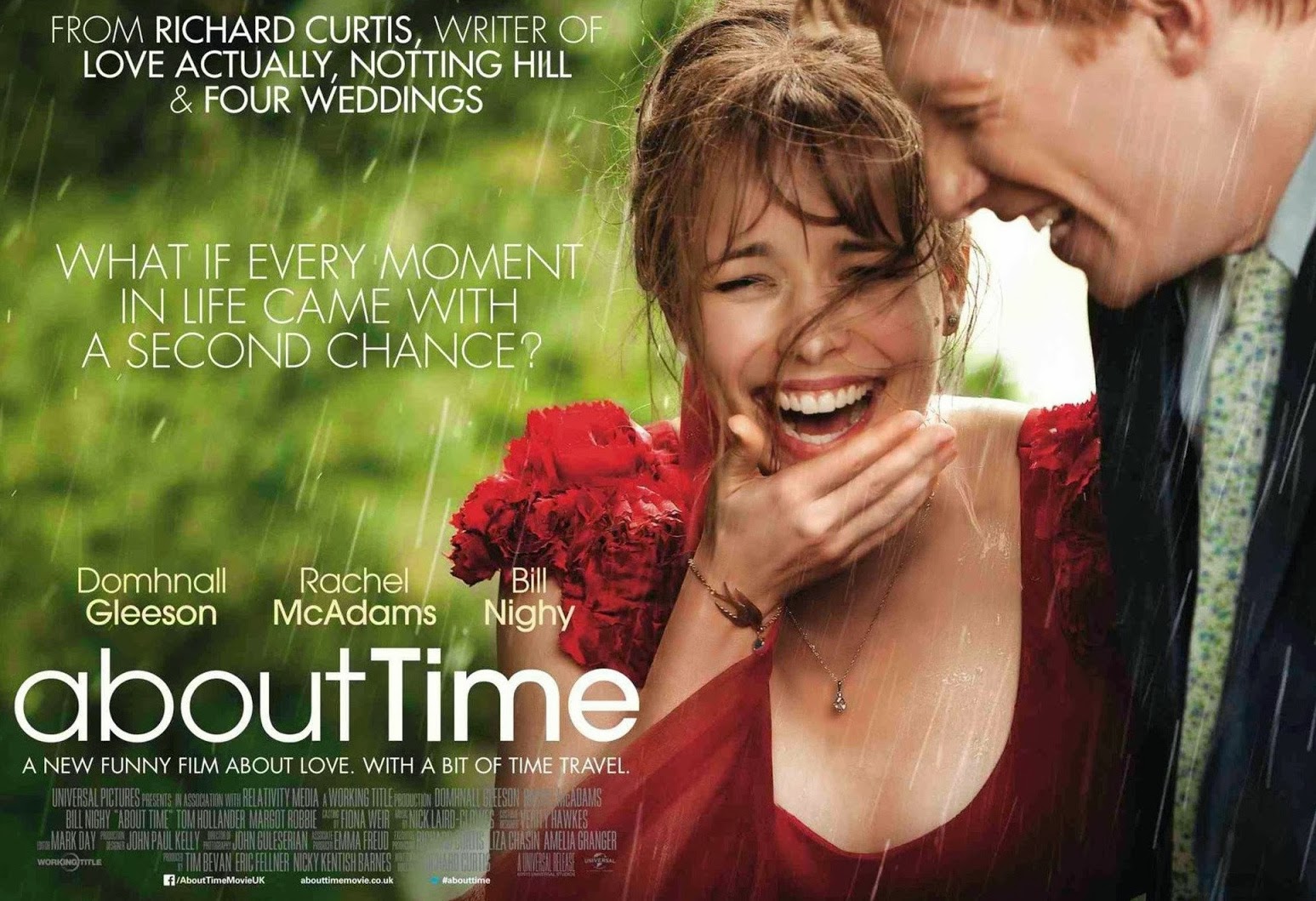
The latest offering from Britain's king of romantic comedies Richard Curtis, About Time is a two hour lesson on how to achieve 'the good life' and that ever elusive 'happiness'. Oh, and time travel. The basic premise is that if you don't get this 'life' business right the first time, just go back and do it again, only better. But then don't, because you've learned that it's better to do it right the first time. Or something like that.

richard curtis' about time review
 
Lesson #1: Smell the roses because, actually, there is no time travel, there are no do-overs, and you only have one chance to get it right.

About Time is not what you'd expect from the poster. Yes, it is a romantic comedy, but the love is about family and not about boy meets girl, romantic love. Fundamentally, this is the story of a young man and his relationships, in particular that with his father.

At 21, Tim's (Domhnall Gleeson) dad, played by the ever charming Bill Nighy, informs him that the men in the family have always had the ability to travel back in time. Of course this immediately leads Tim to time warp back to a New Year's party to kiss a girl. Tim goes on to use his new found abilities to search for love, finding disappointment instead, before he ups and moves to London. There, after a time, he uses it to help a friend, which consequently leads him to never had met the love of his life (Rachel McAdams). Fear not, as the situation is soon rectified and Tim continues to jump through time in the pursuit of happiness.

Lesson #2: Time travel doesn’t always get you what you want, and it can’t make someone love you.

Curtis, who brought us Love Actually, Notting Hill and Four Weddings and a Funeral (they're all listed on the poster, in case you were confused), brings us yet another utterly smug, not entirely unlikable, but very middle class morality tale. However, this time there's a bit of timey-wimey travel thrown in for good measure. To be honest I'm not sure why, on the time travel. There are apparently no consequences from all the jumping back and forth, except maybe for one quite major issue that is somehow overcome even in defiance of the logic presented - I won't spoil it, but it has something to do with a very particular sperm and an equally particular egg.

Lesson #3: Children are happiness, so have three.

Honestly, if not having children is a sore point for you, this film will either make you weep uncontrollably into a tub of ice-cream or throw heavy blunt objects at the screen.

I had hoped that the unintended consequence of this supernatural familial trait was the apparent madness that besets both Tim's uncle Desmond (Richard Cordery) and sister Kit Kat (Lydia Wilson). That would have brought some conflict and drama to the story, but no. And this is what is missing from About Time - the story. There doesn't really appear to be one. It's an observation of a life, but there is limited conflict, and where it does crop up it is relatively simply dismissed. Yes, there is death, yes, there is general life chaos, yes, there are issues of mental health, but each of these is passed over as we witness from the perspective of a young lad chasing his own happiness, at his own will, across time.

richard curtis' about time review

The performances are fine, nothing outstanding, although I am beginning to lose patience with McAdams' seemingly eternal portrayal of 'love interest', or more specifically 'love interest in a romance with some element of time travel'. In About Time she is convinced she's altogether ordinary - courtesy of a slightly unflattering (read, alternative) haircut - making those of us who are actually ordinary feel utterly useless. Gleeson is charming and so easily middle class English, which is an achievement being the son of the quintessentially Irish Brendan Gleeson. Bill Nighy plays a variation from the spectrum of Bill Nighy, but I'm okay with that.

I think the best summation of About Time lies with The Guardian, which called it 'Groundhog Day with a ginger Hugh Grant'. Apt.

As an aside, a massive part of me wishes that Curtis could bring back the brilliance that was Not the Nine O'Clock News and Blackadder. What is evidently missing from our movie screens is that expression of self-deprecation and satire that pokes fun at the absurd reality that surrounds us. It seems we're altogether too serious now, or too boring, or our concept of cinematic humour is tied up in bodily functions. Shame.

About Time is in cinemas from 17 October.

-Stevie O'C

read more

No Thanks For Sharing

,

Thanks for Sharing is Director Stuart Blumberg’s Hollywood debut. An ensemble film starring Mark Ruffalo, Gwyneth Paltrow, Tim Robbins, and Alecia Moore (better known as Pink) it's pitched as a ‘dramedy’, or drama-comedy to us lay-folks, about sex addiction. However, Thanks for Sharing never quite manages to achieve either the ‘drama’ or the ‘comedy’ aspects successfully enough to combine the two. Some of the most powerful stories are those that manage to offset utter tragedy with just the right level of humour to hammer home the message - Thanks for Sharing is not an example of this. This film is not what you think it is, judging by the poster anyway.

Thanks for Sharing theatrical poster

I had a number of issues with this film, but mostly I was bothered by the superficial way in which the impact of addition on other people is almost entirely glossed over. Take, for example, Mike’s (Robbins) long suffering wife (Joely Richardson) and son (Patrick Fugit). In a passing discussion we learn he has given his wife Hepatitis-C and all too briefly we learn that the reason his son has gone off the deep-end is due to being the constant subject of negativity and rage from a father who is a violent drunk. Nor do we know why Phoebe (Paltrow) refuses to date another addict beyond her statement that it’s all too complicated.

In truth, the film doesn't even consider the real impact addiction can have on the addicts themselves. We don’t really know what Adam (Ruffalo) has been through to get to his five years, although we do briefly see how superficial his sobriety is. But it’s not sobriety so much as it is outright exclusion from modern life in many respects. Continuing with the superficiality, we have no real concept of Dede’s (Moore) experience beyond her introductory statement that without 'another way' she’d end up killing herself. Powerful stuff but it is left hanging. This, unfortunately though, is the only way this film can deal with anything that can’t be pointed and laughed at.

And this is where I have a fundamental problem. Worse than the treatment of those characters already described is the lack of acknowledgement that the character of Neil (Josh Gad), a doctor and someone in a position of power and trust is actually a sexual deviant. He has been up on some sort of charges relating to his ‘addiction’ as he is attending group sessions not voluntarily but because a court ordered him to do so. Given that in some American states you can be put on a sexual predator list for having a wee outdoors, I fail to understand how he is allowed back into the ward at all.

It’s also scary to think that the tapes he destroys later in the film are videos he has shot himself. Of what, and of whom is not actually revealed but the path we are led down is a frightening one. Instead, Neil is played as the misunderstood lovable rogue, with no consideration of the impacts on those whom he has violated for his own gratification either on public transport, as patients or as colleagues. And I'm sorry, but he’s not going to go from a chronic up-skirting habit to burning tapes and singing Kum-ba-ya in what, thirty days?

It’s really not clear what the film is trying to achieve with the character of Phoebe. Her obsessions are obviously intended to present a contrast to Adam's, with Phoebe’s presented as eccentric, quirky and a bit weird while Adam’s are apparently beyond his own control. Here’s the thing though, Phoebe’s preoccupation with health, fitness and food appear to be motivated by an actual disease, being cancer, while Adam’s constant referral to his own obsession as a 'disease' presents a degree of self-righteousness and arrogance in the character, almost a sense of my suffering is worse than your suffering, which eventually comes to undermine their relationship.

Competent casting means that there is nothing wrong with the performances. Ruffalo plays his Adam as charming for the most part, until he adopts the victim mentality and we see glimpses of a potential arsehole. Robbins delivers some absolute clangers with conviction, however in an effort to be perpetually Zen his character is one dimensional in situations where you’d think he’d be far more multifaceted. The rest of the cast is equally competent but restrained. On the whole the film and its characters suffer from this idea that the middle classes cannot be anything other than one emotion, all of the time, and plays this as being normal.

And thoroughly middle class this film is. Even Pink’s ‘alternative’ character has a day job in a hipster hair salon. It deals with none of the underlying causes of addiction, nor does it look into the consequences of addiction in any meaningful way. But then how could a dramedy, really? All you need to know is that middle class life is hard.

Thanks for Sharing is in cinemas October 3.


read more

R.I.P.D. Off

,

R.I.P.D. (Rest In Peace Department) or ‘Men in Black from beyond the grave’ is based on a graphic novel of the same name, which I'd never heard of before the movie. Nowadays whenever someone tells me ‘hey, it's based on a graphic novel’, it’s with some trepidation that I go along, and I almost always leave the theatre of the opinion that it should have stayed a graphic novel.

Look, it isn't all crap. The internal consistency of the R.I.P.D. world is solid, the acting is ok, and there are a couple of neat action scenes. But that's all the nice it's gonna get from me.


Here’s the low down: Some time in the past, Nick Walker (Ryan Reynolds) and partner Bobby Hayes (Kevin Bacon) stumbled upon some gold during a drug bust and split the findings. Walker is now apprehensive and wants to turn it in. While on a raid, Hayes corners Walker, reveals that he can't let him handover the gold, and kills him.

On his way to eternal judgement, Walker is yanked from his ascension and given a job tracking down ‘Deados’ (spirits that somehow slipped through the system and continue to walk the Earth avoiding judgement) to arrest them for processing. He is partnered with a cranky old Marshall from the 1800s who prefers to work alone (Jeff Bridges). The two must track down and arrest rogue Deados while disguised as a senile Asian man and a hooker, which is played for a few cheap laughs that quickly wear thin.

Deados look like any average human, but are really just bad CGI in disguise, which, when they get a whiff of curry powder, go all Jar-Jar Binks and gimmick out for your 3D viewing pleasure.

What begins as an interesting premise quickly degenerates into a film that's confused about how to shoe-horn adult themes, like drug busts, death and rampaging destruction, into kid-friendly Disney-esque slapstick. It plays on so many conventions you can almost hear the committee decisions that went into every scene. Hero had a wife he loved? Boo-hoo. His ex-partner turns out to be the Big Bad? Surprise. Cops are taken off the case only to disobey a direct order and solve it anyway? I now believe lazy film-makers do this just to fast-track a resolution.

What actually bugs me the most about R.I.P.D., though, is the CGI. It is a real step back in technique and technology. The design of the Deados makes no sense and when one has been revealed it isn't so much scary as annoyingly stupid. They are lumbering buffoons, not fear-inducing zombie thugs, which is what I think they were going for.

If you do inflict this film on yourself, you'll walk out wondering wha..? Huh? I... no... wha..?

You have been warned.


R.I.P.D is currently in cinemas.
read more

Blue Jasmine: A Review

,

To be honest, had I known Blue Jasmine was a Woody Allen film I probably wouldn’t have gone along to see it. I haven’t switched on an Allen film since the first ten or so minutes of 2005’s Match Point, so it would have been with extreme trepidation that I’d have given another a go with fair warning.
Funnily enough, Blue Jasmine is the quintessential Allen film, which I still hadn’t cottoned onto until after the film, when I had to be told and it came as a bit of an ‘aha’ moment. But it’s Allen at his best, and is more akin to his 1970s/80s work than anything more recent.

Cate Blanchett plays Jasmine, who was married to Hal (Alec Baldwin) until his investments and her marriage went belly up and she lost everything. This sees her land on her sister Ginger’s (Sally Hawkins) doorstep with her Louis Vuitton cases piled high but utterly broke and quite mad. Through a series of flashbacks the sorry tale that is the collapse of Jasmine’s marriage and her mind is revealed.

Having never been to either, I’m pretty sure Allen’s San Francisco is more New York than it is San Fran. That aside, the story is one based on a certain kind of voyeurism that compels us to bear witness to the progressive downfall of someone we all hope is kind of deserving of their own fate. It’s watching the fall from grace of someone who is predominantly unsympathetic and unlikeable, but an accurate characterisation of The Real Housewives of [insert random American metropolis here]. I hate her, but I desperately want to see what happens to her, and secretly want it to all go very, very wrong.

The film is skilfully acted, with Blanchett an absolute stand out in a very theatrical portrayal of a woman unable to come to terms with the loss of the lifestyle to which she had become accustomed, or that of her own mind. Hawkins portrayal of the sister left behind is genuine, even when she’s doing what she can to help her sister despite the damage Jasmine has previously caused her – because that’s what family does. The dynamic between the two sisters, who have been separately adopted from different biological families, makes for interesting motivation, especially given the circumstances in which they find themselves, and Allen handles it well. 

Bobby Cannavale as Ginger’s boyfriend, Andrew Dice Clay as Ginger’s former husband, Peter Sarsgaard as Jasmine’s potential new suitor, and Louis C.K. as Ginger’s momentary lapse in judgement all offer up strong support.

Blue Jasmine is in cinemas from September 12.

-Stevie O'C

read more