Showing posts with label film. Show all posts

12 Years a Slave: A Review

,

Before the screening for this film began, I ordered a large glass of wine from the bar. I wanted to numb myself. I had not watched any trailers for Steve McQueen’s latest film, or read Solomon Northup’s memoir of his experiences as an abducted slave. Regardless before having seen a single frame, I was already experiencing a strong sense of foreboding.

Steve McQueen's 12 Years a Slave: A Review

McQueen has proven himself to be a film-maker who both is fearless in his subject matter – the deprivation of the Northern Irish political detainees in Hunger is unforgettable – but also fully aware of how film can confront the audience. The topic of slavery within Hollywood has previously been treated as an unfortunate event in history – and so depicted in disaffected fashion as a curio; as a sadistic standby in exploitation cinema; or most famously, entirely justified as in the work of D.W. Griffith’s The Birth of a Nation.

McQueen is not interested in such segues or historical sleight-of-hand. 12 Years a Slave opens with Chiwetel Ejiofor standing among a group of slaves, men and young boys, staring at the camera dejectedly. It is a confronting opening shot, but it also immediately places the audience in that moment. The ambient sound of the cornfield, the buzzing of insects and this silent group, waiting to be told what to do, completely bereft of agency, all combine together to deliberate effect.

Steve McQueen's 12 Years a Slave: A Review

The story skips back in time, introducing Ejiofor’s Solomon as a family man making a comfortable living as an entertainer. He dresses in the clothing of the New York middle class and draws the envious gazes of born slaves, who are baffled by his freedom and equality with his white peers. Solomon is approached by two men who offer him a short profitable job in Washington. During his travels with them, he is drugged and wakes to find himself pressed into a slaver’s ship bound human cargo. There he is stripped of his clothes and name – he learns quickly that any protest about his true identity can lead to his death.

The sudden reversal of Solomon’s fate is a sharp shock, again designed to force a sense of empathy on a modern audience. In addition the shrill violins of Hans Zimmer’s score – acting as a chorus, given Solomon’s own gifts as a violinist – evoke the desperation and pain of these victims of callous slavers.

Sold initially to the morally troubled, but weak-willed William Ford (Benedict Cumberbatch) Solomon tries to makes himself useful, in the hope that his evident skill at carpentry will allow him to convince his owner that he is more valuable as a free man. His plan fails disastrously and he is passed on to Edwin Epps, played by frequent McQueen collaborator Michael Fassbender. Trapped by an unpredictable, brutal sadist, his dreams of escape are slowly ground into dust.

What impresses most is how the torture and abuse of the slaves is not depicted in a sensationalistic fashion, its everydayness making it doubly disturbing to watch unfold. Epps orders slaves who fail to meet a daily quota for cotton picking be whipped, of which there are glimpses in long shots. McQueen also avoids the trope of 12 Years… being a story of redemption for his male protagonist. Solomon instead is forced to witness the suffering of women in particular, an aspect of American slavery that has been sidelined in previous films set during this period.

Cumberbatch’s performance shows what he is capable of when given the chance to escape from Tumblr. Fassbender is simply terrifying, a ball of rage liable to explode at any moment. One tension-filled scene between Epps and Solomon in the dead of night is an acting masterclass.

Steve McQueen's 12 Years a Slave: A Review

However, it is the women on screen that impress the most. The magnetic Lupita Nyong'o gives Fassbender a run for his money during their moments together and the grief of Adepero Oduye’s Eliza at the loss of her children is heartrending. Sarah Paulson plays the wife of Epps and essays another rarity in the film subgenre of slavery pictures, a white woman devoid of any sympathy towards the slaves on her property, actively abusing Patsey (Lupita Nyong’o). Ultimately the plot movements of this film are set in motion by the actions of the women, not the men, with Solomon an especially passive observer.

McQueen has delivered an inspired piece of film that refuses to settle into received ideas of how slavery should be depicted. This is a thoroughly modern and innovative picture, emotionally devastating, but invigorating thanks to directorial technique and the commitment of its cast.

12 Years a Slave is in cinemas from tomorrow - 30 January.


read more

Philomena: A Review

,

Stephen Frears’ latest film takes inspiration from Martin Sixsmith’s novel The Lost Child of Philomena Lee, becoming a subtle meditation on the nature of forgiveness while not shying away from the despicable behaviour of the Irish Catholic Church (link contains information that may be considered spoilers).

Movie Review: Philomena. Judi Dench Steve Coogan

Philomena is played by Judi Dench, who nails the West of Ireland accent. Still grieving for an absent son sold for adoption by the nuns in charge of a Magdalene laundry where she was indentured as a teenager, she finally confesses to her daughter Jane (Anna Maxwell Martin) the existence of this secret sibling Anthony. Steve Coogan’s Martin Sixsmith meanwhile is still reeling from the ignominious end of his career within the Blair administration. A chance encounter with Jane leads her to try to convince him to tell her mother’s story, which he cynically dismisses as cheap human interest misery-journalism fit for tabloids. 

The barely repressed venom in Coogan’s delivery of this line is a neat indication of the script’s intent, which the actor also had a hand in writing. Eschewing the tropes of misery lit and impotent rage at the tragic events surrounding the laundries, Philomena instead not only depicts this injustice but tempers anger with clear-headedness. Martin eventually does agree to meet his subject having successfully pitched the article to an editor, wonderfully played by Game of Thrones’ Michelle Fairley ('who are the bad guys?'), and finds himself won over by the self-effacing plight of this elderly woman.

Movie Review: Philomena. Judi Dench Steve Coogan

What follows is a road movie of sorts, with Philomena and Martin travelling across to the States and back again, hunting down the trail of Anthony fifty years cold. Frears balances flashbacks to the years working at the Roscrea convent, the hardship endured by the young mothers in the laundries and the loving warmth of their brief time spent with their children. Sophie Kennedy Clark, who has gone from playing a British royal in Black Mirror to a naive Irish woman, stands in as a younger Philomena. Her distress at the loss of Anthony is raw and powerful. Dench sells just how enduring this emotion lingers decades later.

A mixture of tragedy and gentle humour eases the audience through the story, with Dench and Coogan introducing a light screwball tone to some of their scenes. There is a recurring joke that Martin is attempting to write a historical work about Russia, whereas Philomena prefers to read dull romance novels and insists on describing the plots to him.

Movie Review: Philomena. Judi Dench Steve Coogan

In contrast, their scenes confronting the 'bad guys' are subtly powerful. Martin is puffed up with righteous anger at the aged Sister Hildegarde who presided over the convent during the 1950s. Philomena, however, remains strong in her religious convictions. She merely wants to know the whereabouts of Anthony so that she can make peace with what happened. The comparison between her enduring religious conviction, being someone directly wronged by the Church, versus the stout atheism of the successful and comfortably middle-class Martin, is repeatedly alluded to.

Ironically Barbara Jefford who appears as the principal antagonist Hildegarde, ranting and raving about fornication, is also known for her portrayal of the sexually sated Molly Bloom in Joseph Strick’s Ulysses (1967).

While the film is pointed in its indictment of how these women and their children were treated, it is not by any means an attack on the Catholic faith itself. Instead it questions the conduct of institutions given full control over the lives of ordinary Irish people and brings them to account. Philomena is an understatedly powerful film.

Philomena is currently in cinemas.

-Emmet O'Cuana

read more

American Hustle: A Review

,

David O. Russell’s American Hustle sees him reunite with the casts of Silver Linings Playbook and The Fighter in what is the latest in his series of films focusing on character instead of plot, lending his actors plenty of emotional space to revel in.

American Hustle: Film Review

Some critics have taken to pigeon-holing American Hustle as an also-ran to Martin Scorsese’s Goodfellas. Thing is, these are two very different films that simply share a period setting as well as a focus on small-time criminals and the cops trying to entrap them.

Whereas Scorsese’s Catholic sensibilities draw him to mine cinematic gold out of America’s rotten heart – perhaps most unforgivably in that ridiculous last shot from The Departed – Russell is instead interested in the fragility of people.

Christian Bale appears on the screen in the opening moments determinedly gluing his comb over to his balding scalp, with a spare tire wrapped around his waist that would make you believe he never did a Bat-push-up. His Irving Rosenfeld runs dry-cleaners and small businesses around New Jersey, but also a neat sideline in conning desperate men who cannot get a loan. His partner in crime is his mistress Sydney Prosser (Amy Adams) who affects a fake British persona of Lady Edith to convince investors to hand over their last $5,000 as a ‘fee’.

American Hustle: Film Review

Unfortunately their latest mark proves to be a Federal Agent. Bradley Cooper’s Richie DiMaso is driven and eager to make his name in the Bureau. He is naively convinced that his black and white perception of the world is true – the memory of Watergate haunts these characters – whereas Irving sees the world as a sequence of greys. Richie pressures Irving and Lady Edith, whom he begins to carry a serious torch for, to entrap the mayor of New Jersey Carmine Polito (Jeremy Renner, terrific is the charismatic community politician).

The stage is set for a love triangle between Irving, Sydney and Richie, as well as a dizzying series of grifts, with it is often unclear whether these characters genuinely feel the emotions they are expressing or are relying on some serious method acting.

Russell highlights this fascinating idea of con men and actors having improvisational skills in common and gives Bale and Adams several generous scenes to show off their talent. The first appearance of Lady Edith is a fantastic case-study of a great actor playing someone who is a bad actor. The setting also allows for not only anachronistic period detail, but the delightfully cheesy poor sense of class that these characters have. Richie’s furious demands for increasingly expensive hotel suites to impress his long line of marks as part of his operation are particularly telling.

American Hustle: Film Review

Much of the film's promotional campaign has centered around Jennifer Lawrence. Her neurotic Rosalyn is a harpy with peroxide hair already trapped in the role of a suburban wife while still a young woman. She also happens to be the loose cannon at the heart of this scam who risks blowing the whole deal wide open.

Russell’s grand theme here is whether graft and corruption can actually serve the greater good. As Irving tries to explain to Richie, Watergate has not opened the floodgates on moral righteousness. American Hustle in that respect has a far more interesting perspective on working class crime than Goodfellas. It is also an acting masterclass, which takes the time to allow the performers to take ownership of their scenes.

American Hustle is currently in cinemas through Roadshow.


read more

Peter Jackson's The Hobbit: The Desolation of Smaug Reviewed

,

When I first heard that Peter Jackson would be making The Hobbit into a prequel film his Lord of the Rings series, I was excited. When I heard there was enough material to fill two films, I gave him the benefit of the doubt. When I heard it was going to be a trilogy, I became a little sceptical.

I'll admit I've not read the book since high school, and in the context of having read The Lord of the Rings trilogy and The Silmarillion, it's a bit of a blur as to what was The Hobbit and was was added from the overarching lore. However, if my shoddy memory serves, the basic premise is that a homebody gets talked into going on a treasure-hunting adventure with a bunch of fun-loving Dwarves, serving to illustrate that the smarts of an unlikely hero can win the day.

The Hobbit: The Desolation of Smaug Reviewed

Thus far the movies have made Bilbo (Martin Freeman) a bit player in the larger story, which is now more about a disenfranchised people questing to reclaim their homeland from a dragon, and redeem themselves from a fall-from-grace.

While this second Hobbit film is, in some respects, better than the first, I found it to be riddled with pointless scenes. For much of the film I truly wondered where this garden path was leading me, desperately seeking some sort of arc in the story. With no beginning and a cliff-hanger ending I find the pursuit of a grand finale, some 12 months away, a flimsy excuse for stringing together a bunch of disconnected scenes of our heroes’ quest to the Lonely Mountain.

In The Desolation of Smaug we continue to explore Middle-Earth with our heroes who are still being pursued by the pack of Orcs that found them at the end of An Unexpected Journey. They encounter Beorn (Mikael Persbrandt) - a were-bear and giant spiders, and are captured by the Elves of Mirkwood Forest, only to escape and be smuggled into Lake-town by Bard (Luke Evans).

The Hobbit: The Desolation of Smaug: A Review

Familiar LOTR tropes are rehashed but not built on or treated in any unique way: Elves still hate Dwarves; if you're cut by a Morgul blade, you need Kingsfoil (a weed) and Elven magic to heal the wound. Yep, we know.

Unfortunately, neither are the characters progressed much here, rather passing relatively unaffected from ordeal to ordeal. Instead, most seem to serve a function: Balin (Ken Scott) is the wise advice-giver and problem-solver, Thorin (Richard Armitage) plays brooding hero, Kili (Aidin Turner) provides some comic-relief, and poor Bilbo has been demoted from titular protagonist to ‘that guy who'll always get them out of trouble’.

Despite this, it does all seem worth it when our band of heroes finally reaches the Lonely Mountain and encounter Smaug the Dragon (voiced by Benedict Cumberbatch).

By this stage in the film I had a serious need to pee. But from the moment Bilbo entered the cave of riches and awoke the slumbering, smooth-talking dragon, every scene featuring this amazingly realised character was worth crossing my legs for.

It is here that the film really begins to shine. Perhaps the dialogue is lifted wholesale from Tolkien’s original, or maybe it’s because Bilbo is finally given a chance to talk rather than bumble along, but something changes and the film is all the better for it.

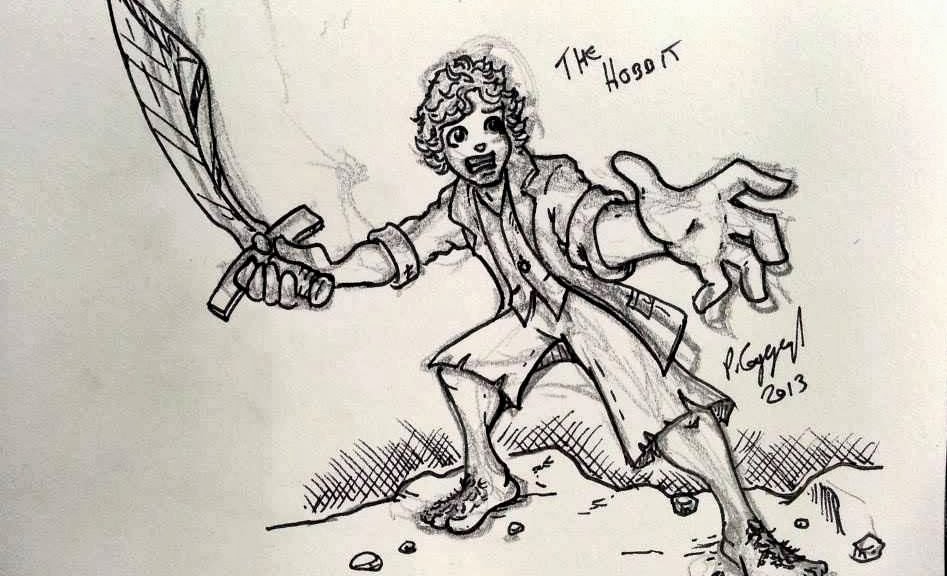
The Hobbit: The Desolation of Smaug Sketch by Paul Caggegi
The Hobbit by Paul Caggegi (http://processdiary.com/)
Unsurprisingly, The Desolation of Smaug ends on a cliff-hanger which will leave you wandering exactly how they are going to fill another 2 to 3 hours with what seems to be a pretty succinct set up of an epic battle. But given much of these prequels have been consciously made to tie in directly to the LOTR films I'm pretty sure Jackson figured it all out years ago.

All in all, I am glad I saw it, even if I did risk a bladder infection. As with each of Jackson’s interpretations there are plenty of beautiful moments, both visually and emotionally. And despite some pithy dialogue we get to escape to Middle-Earth for yet another few hours. It is spectacular but certainly feels drawn out, maybe we didn’t need that second breakfast after all.

The Hobbit: The Desolation of Smaug is in cinemas from Boxing Day.

read more

Thor('s Day): The Dark World

,

Today is Thor's day. It also happens to be release day for Marvel's Thor: The Dark World. See what they did there?

Marvel's Thor 2 The Dark World with Chis Hemsworth, Tom Hiddleston and Natalie Portman

Earlier this week I watched David and Margaret pan this, the latest in the Marvel franchise and the sequel to 2011's Thor (but which takes place after the events of The Avengers). They said it's same ol' same ol'. They said there's nothing new to see here. They said it's superficial, bang, crash and pretty-boy heroes.

To be honest none of this comes as a surprise to me. In fact my thoughts as I watched these armchair critics from the comfort of my own armchair were firstly, what did you really expect? And with that in mind, do you really care that it's likely to be superficial, generic story telling and fantastical escapism? Like, really care?

I haven't seen Thor II but the likelihood of me doing so is pretty high. As you may have gathered by now, I have a completely at arm's length happily married lady crush on Tom Hiddleston, who plays the mischievous adopted god, Loki. I also reckon if Chris Hemsworth knocked on my door trying to flog me Foxtel I'd obligingly invite him in, brew him a cup of tea and hand over my credit card details.

Marvel's Thor 2 The Dark World with Chis Hemsworth, Tom Hiddleston and Natalie Portman

Without having seen the film I'd say Margaret and David would be close to spot on with their assessments. So too am I confident that this is exactly what Marvel is pitching at. Given the amount of whinging from fanboys that accompanied the release of Iron Man III for its deviating from the dogma I can well believe they've gone back to formula - world at risk, motivated hero, love story, hero challenged, world saved - for this stop gap between the last and the next Avengers films.

I personally really enjoyed Iron Man III. I thought it was, while imperfect, relatively intelligent and poignant for a superhero movie. For me it was an interesting commentary on heroism, politicking and media, with the added bonus of Robert Downey Jr. But I can't expect all Marvel films to do this. I, in actual fact, am probably not the Marvel target market. I'd argue neither are David and Margaret.

The Marvel films are a product. First and foremost. The Marvel films are not produced for art. They are a commercial enterprise, which, in many respects, is what cinema has become.

Director Alan Taylor has himself spoken out about the treatment his film was given by the studio. According to Taylor, re-shooting, rewriting and the inclusion of new scenes even after production has ended is 'the Marvel way'. In a brief interview with Collider, Taylor admits to the inclusion of additional scenes featuring Loki, which one can only imagine have been added on the back of the audience and fan reception to Hiddleston's portrayal of the character and growth in his personal capital following the success of The Avengers.

In another interview with the Huffington Post, Taylor is oddly overt about the structure of the final film, of which the first 45 minutes is exposition. According to Taylor this all came about in post, or as he put it, was 'discovered along the way'. His preference, it appears, was for earlier versions of the film, which placed more 'trust the audience'. But the 'decision was made', leaving one to wonder who is really in control.

Well, in actuality I was never really in doubt. It's made all the more obvious with the inclusion of a snippet in the middle of the credits, which is apparently a blatant marketing ploy for the soon to be released flick Guardians of the Galaxy from yet another Marvel movie universe. Directed by James Gunn (who has also directed Guardians), Taylor notes that it's a shift in tone and probably not what he would have done with the scene. Interesting. But as Taylor notes, it's Marvel's way to make things 'better'.

In any case, Marvel can pretty well count on my money at the box office on this one. I don't always want smarts from my superheroes. Sometimes I just want muscly blokes with superhuman abilities making things go boom. It's about escapism, fantasy and zoning out for a couple of hours. I'd be silly to expect more.

Thor: The Dark World is in cinemas from 31 October.


read more

The Superficial: The Bling Ring Reviewed

,

One of my favourite guilty pleasures is to sit down with a big block of chocolate and a juicy gossip magazine. It is fun to peek into the world of the rich and famous, to catch up on who is dating who, the latest teen singing sensation in a fast lane to rehab (cough, Miley Cyrus, cough). I particularly enjoy admiring their designer outfits and how they manage to look so perfect all the time. However, for the four Los Angeles teenagers in Sofia Coppola’s latest film The Bling Ring, the life of celebrity and high-end luxury is more than a passing interest – it is an obsession.

the bling ring review

When Marc (Israel Brussard) begins at a new high school, he is shunned by everybody except the pretty and confident Rebecca (Katie Chang).  Marc is pleased when they discover a mutual interest in fashion, and Rebecca is excited to find that Marc’s father is ‘in the biz’ as a film distributor. What begins as a typical teenage friendship made up of parties, trips to the beach and smoking weed, quickly becomes something more serious when they embark on a series of burglaries, accompanied by ditzy Nicki (Emma Watson), her adopted sister Sam (Taissa Famiga) and fellow party girl Chloe (Claire Julien).  They don’t just rob any old homes, though.

The Bling Ring is based on the real life events described in the Vanity Fair article, ‘The Suspects Wore Louboutins’. The article details the crime spree that saw the teens steal US$3 million worth of jewellery and designer clothing from the mansions of celebrities they admired, including Paris Hilton, Orlando Bloom and Lindsay Lohan during 2008 and 2009.  The ‘Bling Ring’, as they became known, used the internet to research the addresses of their favourite celebrities and targeted them on nights they’d be away filming or attending events. They got in using keys hidden under doormats or via unlocked doors. Who knew it would be so easy?

Co-written by the article’s author Nancy Jo Sales, the film is relatively close to the events as described. Taking the perspective of the teens involved, it follows them as they ransack one celebrity home after another. However, there wasn’t much else to it, and without a fuller storyline it struggled to maintain my interest.

For a film, the story needed to be more substantial. Although the opportunity to develop the characters presents itself, this is where the film falls flat. We really know nothing about them, apart from Nicki and Sam bring products of their mother's (Leslie Mann) misguided home schooling curriculum based on The Secret, that Rebecca comes from a broken home, and that Marc has anxiety issues garnered via a passing remark. Also not revealed are their motives for partaking in this series of audacious crimes.

What the film does say about these characters is that they reflect a generation that is narcissistic, superficial and obsessed with fame. In the world of The Bling Ring, having a ‘DUI’ (driving under the influence) conviction like Lindsay Lohan is something to be celebrated, and life goals include owning a collection of Louboutin shoes, appearing on TMZ or having your own reality TV show. On the one hand, the film’s visual style is very reflective of this and looks like a television advert or gossip magazine, interspersed with Facebook profiles and pics, white at other times it has a very dreamy feel more akin to Coppola’s Lost In Translation.

the bling ring review

What I most enjoyed about the film was Emma Watson’s performance as Nicki, who is perhaps the most superficial and fame obsessed of the bunch. My favourite line in the whole film, sadly based on an actual quote by one of the real-life Bling Ring members, is delivered by Watson, surrounded by paparazzi as she enters the courthouse to face trial:

“I’m a firm believer in Karma and I think this situation was attracted into my life because it was supposed to be a huge learning lesson for me to grow and expand as a spiritual human being...God didn’t give me these talents and looks to just sit around being a model or being famous. I want to lead a huge charity organization. I want to lead a country, for all I know.”

God help us all.

The Bling Ring is out on DVD and Blu-Ray through Roadshow.


read more