When I first heard that
Peter Jackson would be making
The Hobbit into a prequel film his
Lord of the Rings series, I was excited. When I heard there was enough material to fill two films, I gave him the benefit of the doubt. When I heard it was going to be a trilogy, I became a little sceptical.
I'll admit I've not read the book since high school, and in the context of having read
The Lord of the Rings trilogy and
The Silmarillion, it's a bit of a blur as to what was
The Hobbit
and was was added from the overarching lore. However, if my shoddy
memory serves, the basic premise is that a homebody gets talked into
going on a treasure-hunting adventure with a bunch of fun-loving
Dwarves, serving to illustrate that the smarts of an unlikely hero can win the day.
Thus far the movies have made
Bilbo (
Martin Freeman) a bit player in the larger story, which is now more about a disenfranchised people questing to reclaim their homeland from a dragon, and redeem themselves from a fall-from-grace.
While this second
Hobbit film is, in some respects, better than the first, I found it to be riddled with pointless scenes. For much of the film I truly wondered where this garden path was leading me, desperately seeking some sort of arc in the story. With no beginning and a cliff-hanger ending I find the pursuit of a grand finale, some 12 months away, a flimsy excuse for stringing together a bunch of disconnected scenes of our heroes’ quest to the
Lonely Mountain.
In
The Desolation of Smaug we continue to explore
Middle-Earth with our heroes who are still being pursued by the pack of
Orcs that found them at the end of
An Unexpected Journey. They encounter
Beorn (
Mikael Persbrandt) - a were-bear and giant spiders, and are captured by the
Elves of
Mirkwood Forest, only to escape and be smuggled into
Lake-town by
Bard (
Luke Evans).
Familiar
LOTR tropes are rehashed but not built on or treated in any unique way:
Elves still hate
Dwarves; if you're cut by a
Morgul blade, you need
Kingsfoil (a
weed) and Elven magic to heal the wound. Yep, we know.
Unfortunately, neither are the characters progressed much here, rather passing relatively unaffected from ordeal to ordeal. Instead, most seem to serve a function:
Balin (
Ken Scott) is the wise advice-giver and problem-solver,
Thorin (
Richard Armitage) plays brooding hero,
Kili (
Aidin Turner) provides some comic-relief, and poor
Bilbo has been demoted from titular protagonist to ‘that guy who'll always get them out of trouble’.
Despite this, it does all seem worth it when our band of heroes finally reaches the
Lonely Mountain and encounter
Smaug the Dragon (voiced by
Benedict Cumberbatch).
By this stage in the film I had a serious need to pee. But from the moment
Bilbo entered the cave of riches and awoke the slumbering, smooth-talking dragon, every scene featuring this amazingly realised character was worth crossing my legs for.
It is here that the film really begins to shine. Perhaps the dialogue is lifted wholesale from
Tolkien’s original, or maybe it’s because
Bilbo is finally given a chance to talk rather than bumble along, but something changes and the film is all the better for it.
 |
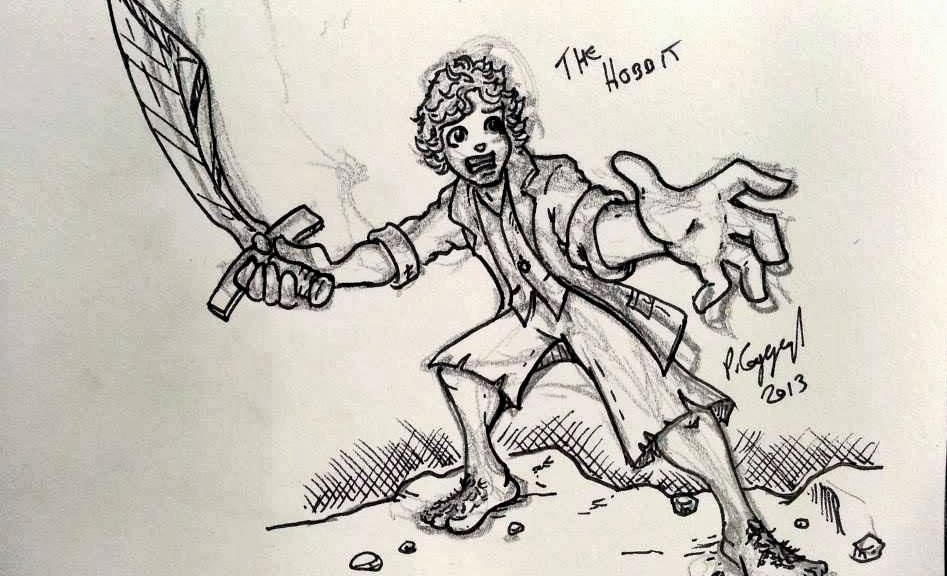
| The Hobbit by Paul Caggegi (http://processdiary.com/) |
Unsurprisingly,
The Desolation of Smaug ends on a cliff-hanger which will leave you wandering exactly how they are going to fill another 2 to 3 hours with what seems to be a pretty succinct set up of an epic battle. But given much of these prequels have been consciously made to tie in directly to the
LOTR films I'm pretty sure
Jackson figured it all out years ago.
All in all, I am glad I saw it, even if I did risk a bladder infection. As with each of
Jackson’s
interpretations there are plenty of beautiful moments, both visually and emotionally. And despite some pithy dialogue we get to escape to
Middle-Earth for yet another few hours. It is spectacular but certainly feels drawn out, maybe we didn’t need that second breakfast after all.
The Hobbit: The Desolation of Smaug is in cinemas from Boxing Day.