Showing posts with label movies. Show all posts

Alternative Valentine's Day Movies

,

So Valentine’s Day. Named after a religious icon of the early Roman church, who probably never existed, the event we know today replaced the date of the pre-existing Rites of the Lupercalia festival. The abridged version: this was a celebration of werewolves that licenced the pre-Christian citizens of Rome to get up to all sorts of beastly shenanigans.

Alternative Valentine's Day Movies

 A certain degree of cognitive dissonance seems to still be present today. This week the Playstation Network is advertising Alternative Valentine’s Day movie sale, pitching violent action movies at disaffected – presumably male – customers.

Here’s the thing guys. There’s nothing wrong with a bit of romance. It was a standard element of most movies until recently when the industry’s marketing geniuses decided that we need genres that drill down to specific emotions. Michael Bay movies, for example, seem to represent the emotion of agitated boredom.

So romance has been gendered as something only women are interested in, whereas anything with explosions is the province of men. I guess that makes Thor: The Dark World the perfect movie so – thanks movie marketing!

For the past few weeks I have been involved in an office-wide dispute. The cause? Richard Curtis’ emotionally manipulatively, tepidly directed – though sporadically well-acted (looking at you Liam Neeson) – Love, Actually. Needless to say I am not a fan. It is an ensemble piece that reduces its characters to clichés and goes so far as to set up a series of Pavlovian responses – the Joni Mitchell song for example – in place of engaging an emotional reaction through storytelling.

In the spirit of fairness here is my list of five romantic films that are actually well-made in their own right.

Last Night (1998)


Alternative Valentine's Day Movies: Last Night (1998)

 I would contrast the vapidity of Curtis’ film with Don McKellar’s Last Night, which takes the end of the world and manages to evoke a sense of just how important love can be. Last Night is also an ensemble piece, one that establishes each of its characters through how they are trying to make peace with, well, the apocalypse. We never learn the cause for the Earth’s destruction – although the continuous daylight and the ability of characters to predict to the very minute when it is about to happen suggests a supernova.

McKellar himself stars as Patrick, a bereaved widower who has decided to spend his last hours on Earth drinking wine on his rooftop. His friend Craig (Callum Keith Rennie) is counting down to the end by indulging in every sexual fantasy he’s ever had. Sandra Oh plays a wife desperately trying to make her way home to meet her husband, who turns out to be director David Cronenberg, a power company rep ringing customers to apologise for the imminent cessation of service.  His secretary, the late Tracy Wright who sadly passed away in 2010, is nursing a strong crush which he is oblivious to. These are all characters trying to make sense of their lives, to make a final connection with other humans, with only hours to spare. Last Night is both comic in its depiction of the end of the world, but also powerfully moving in its vision of the importance of being with others.

Frankie and Johnny (1991)


Alternative Valentine's Day Movies: Frankie and Johnny (1991)

No end of the world here. This is a straight up working class romance starring Michelle Pfeiffer and Al Pacino. Johnny is an ex-con who takes a job at a diner, where he meets Pfeiffer’s Frankie, a put-upon waitress. The casting caused controversy at the time, as Kathy Bates had originated the role on stage in Frankie and Johnny in the Clair de Lune. Pfeiffer’s luminous beauty was only slightly dimmer for the role but in fairness to the actress, despite the Hollywood casting she delivers an excellent performance.

Pacino is also great in a less-mannered-than-usual role. His explanation of the impact of prison-life on his sexual performance is a laugh out loud moment (to reassure readers, it is not a rape joke). Nathan Lane also appears as a gay neighbour of Johnny’s and the film earned a GLAAD award for its, for the time, sympathetic portrayal of LGBTQ lifestyles. Garry Marshall’s film is sweetly funny and a well-observed portrayal of a relationship strained by real-world circumstances.

Romance & Cigarettes (2005)


Alternative Valentine's Day Movies: Romance & Cigarettes (2005)

 John Turturro’s romantic musical has its ups and downs – it’s certainly not a home-run – but there is still more feeling and pathos here than in most recent cookie-cutter rom-coms. It’s a film about a husband, played by James Gandolfini (yup, he sings), whose marriage is thrown into strife when his wife (Susan Sarandon) discovers his infidelity with a lingerie saleswoman (Kate Winslet). Also, Gandolfini’s curiously named philanderer Nick Murder has just learned he has cancer; so not your typical fare then.

It needs to be said that the film is worth the price of admission alone for Christopher Walken’s song and dance number to Tom Jones’ Delilah.

The story resembles a Jarvis Cocker song – full of low-key observations about desire and the fickleness of mortality – with a soundtrack of blue-collar musical favourites for the cast to belt out. Mandy Moore, Mary Louise Parker, Eddie Izzard, Bobby Cannavale and Steve Buscemi all pop up and give it their best shot. It is Gandolfini’s delivery of Englebert Humberdinck’s A Man Without Love, which then builds to the whole neighbourhood joining in, that sticks in the memory.  His character is selfish and conceited – yet you can’t help but feel for his futile grasping for one last gasp of love. Romance & Cigarettes is a truly distinctive romantic film, with a soundtrack to die for.


Bringing Up Baby (1938)


Alternative Valentine's Day Movies: Bringing Up Baby (1938)

 Screwball comedies get written off as light and insubstantial, but beneath the rapid-fire banter the best of the form have a revving engine of finely tuned plot mechanics. This Howard Hawks classic is deathless in its appeal; silly, delightful and still very, very funny. Katharine Hepburn and Cary Grant were never better together and the titular Baby – a tamed leopard – actually makes you feel slightly nervous for the manic actress. The pair had previously performed together – with Grant using something closer to his original English accent – in the cross-dressing comedy Sylvia Scarlet and would reunite again for The Philadelphia Story two years later. Here their chemistry is fantastic, which leads to some great, off-the wall banter between the two.

Grant’s sheltered palaeontologist David Huxley is set to make his name with the presentation of a reconstructed dinosaur skeleton, though romantically frustrated by his devoted fiancée Alice Swallow (an amusingly officious Virginia Walker) who insists on waiting until their wedding day before consummating their relationship. The day before he meets the spoiled heiress Susan Vance (Hepburn), who confuses him for a zoologist and blackmails him into helping her tame her pet tiger, Baby. It quickly becomes clear that Susan is inventing reasons to keep David around – she also happens to have substantial leverage as her aunt is a prospective financial donor for his work – going so far as to deliberately get the two of them arrested. Driven to distraction, the film famously has a scene with Grant in a dressing gown jumping up and down and shouting that he feels ‘gay all of a sudden’, David unwittingly becomes increasingly fond of this maddening woman. This is not only a sweetly comical romance, but a great all-round film.


A Matter of Life and Death (Stairway to Heaven) (1946)


Alternative Valentine's Day Movies: A Matter of Life and Death (Stairway to Heaven) (1946)

A classic British film from the unstoppable Powell and Pressburger (although the scandal surrounding 1960 film Peeping Tom would put paid to the former’s career), A Matter Of Life and Death (also known as Stairway to Heaven) has the effortless charming David Niven as a WWII pilot who falls in love with an American radio operator (Kim Hunter) moments before his plane crashes. Instead of dying, he finds himself on a beach on the English coast and wouldn’t you know it, June the woman he – rather literally – fell for happens along to meet him. 

It is only afterwards that Niven’s pilot Peter is contacted by The Other World, which explains the metaphysical bureaucratical error. He should have died flying his plane, but somehow in the fog his psychopomp missed him. Peter is given the option of arguing his case – why should he be allowed to continue to live – before a court of his Heavenly peers.

There is poignancy to the wartime setting, beautifully balanced with the whimsical romanticism of Peter and June fighting against the odds to remain together. The stairway to Heaven sequence remains impressive, with the following court-room comedy still very laugh-out-loud worthy. The film is also interesting for its romanticising of the so-called Special Relationship – turns out members of the afterlife at Peter’s trial still hold grudges from the War of Independence – and the light secularisation of the heavenly space, which is never actually referred to as Heaven. An unlikely tribute to the directing pair behind the film would later appear in Bill & Ted’s Bogus Journey.
- Emmet O'Cuana

read more

12 Years a Slave: A Review

,

Before the screening for this film began, I ordered a large glass of wine from the bar. I wanted to numb myself. I had not watched any trailers for Steve McQueen’s latest film, or read Solomon Northup’s memoir of his experiences as an abducted slave. Regardless before having seen a single frame, I was already experiencing a strong sense of foreboding.

Steve McQueen's 12 Years a Slave: A Review

McQueen has proven himself to be a film-maker who both is fearless in his subject matter – the deprivation of the Northern Irish political detainees in Hunger is unforgettable – but also fully aware of how film can confront the audience. The topic of slavery within Hollywood has previously been treated as an unfortunate event in history – and so depicted in disaffected fashion as a curio; as a sadistic standby in exploitation cinema; or most famously, entirely justified as in the work of D.W. Griffith’s The Birth of a Nation.

McQueen is not interested in such segues or historical sleight-of-hand. 12 Years a Slave opens with Chiwetel Ejiofor standing among a group of slaves, men and young boys, staring at the camera dejectedly. It is a confronting opening shot, but it also immediately places the audience in that moment. The ambient sound of the cornfield, the buzzing of insects and this silent group, waiting to be told what to do, completely bereft of agency, all combine together to deliberate effect.

Steve McQueen's 12 Years a Slave: A Review

The story skips back in time, introducing Ejiofor’s Solomon as a family man making a comfortable living as an entertainer. He dresses in the clothing of the New York middle class and draws the envious gazes of born slaves, who are baffled by his freedom and equality with his white peers. Solomon is approached by two men who offer him a short profitable job in Washington. During his travels with them, he is drugged and wakes to find himself pressed into a slaver’s ship bound human cargo. There he is stripped of his clothes and name – he learns quickly that any protest about his true identity can lead to his death.

The sudden reversal of Solomon’s fate is a sharp shock, again designed to force a sense of empathy on a modern audience. In addition the shrill violins of Hans Zimmer’s score – acting as a chorus, given Solomon’s own gifts as a violinist – evoke the desperation and pain of these victims of callous slavers.

Sold initially to the morally troubled, but weak-willed William Ford (Benedict Cumberbatch) Solomon tries to makes himself useful, in the hope that his evident skill at carpentry will allow him to convince his owner that he is more valuable as a free man. His plan fails disastrously and he is passed on to Edwin Epps, played by frequent McQueen collaborator Michael Fassbender. Trapped by an unpredictable, brutal sadist, his dreams of escape are slowly ground into dust.

What impresses most is how the torture and abuse of the slaves is not depicted in a sensationalistic fashion, its everydayness making it doubly disturbing to watch unfold. Epps orders slaves who fail to meet a daily quota for cotton picking be whipped, of which there are glimpses in long shots. McQueen also avoids the trope of 12 Years… being a story of redemption for his male protagonist. Solomon instead is forced to witness the suffering of women in particular, an aspect of American slavery that has been sidelined in previous films set during this period.

Cumberbatch’s performance shows what he is capable of when given the chance to escape from Tumblr. Fassbender is simply terrifying, a ball of rage liable to explode at any moment. One tension-filled scene between Epps and Solomon in the dead of night is an acting masterclass.

Steve McQueen's 12 Years a Slave: A Review

However, it is the women on screen that impress the most. The magnetic Lupita Nyong'o gives Fassbender a run for his money during their moments together and the grief of Adepero Oduye’s Eliza at the loss of her children is heartrending. Sarah Paulson plays the wife of Epps and essays another rarity in the film subgenre of slavery pictures, a white woman devoid of any sympathy towards the slaves on her property, actively abusing Patsey (Lupita Nyong’o). Ultimately the plot movements of this film are set in motion by the actions of the women, not the men, with Solomon an especially passive observer.

McQueen has delivered an inspired piece of film that refuses to settle into received ideas of how slavery should be depicted. This is a thoroughly modern and innovative picture, emotionally devastating, but invigorating thanks to directorial technique and the commitment of its cast.

12 Years a Slave is in cinemas from tomorrow - 30 January.


read more

Spike Jonze's Her Reviewed

,

“It’s good to be around someone that’s excited about the world. I forgot that existed.”

Spike Jonze has seen the future and it is very convenient. Her depicts a near-future L.A. that appears to have been annexed by Apple. The digital citizens of this pastel utopia conduct most of their daily activity through virtual space, appear to want for nothing and work at professions that balance creativity with profit, and wear very high pants. The film takes place in an almost insufferably middle-class setting, absent any hint of conflict or deprivation.

Spike Jonze's Her - Movie Review

Theodore Twombly (Joaquin Phoenix) is introduced reading aloud what appears to be a touching love letter. Then comes the reveal that Theodore writes correspondence for a living, occasionally managing both sides of an intimate conversation between the loved ones who employ him. His computer translates his spoken words into beautiful long-hand writing on a printed page, which is then forwarded on to the addressee. The simple act of letter-writing has become fetishised and transformed into a business transaction.

Lonely following the breakdown of his own marriage, the instinctively empathetic Theodore installs a new form of household Operating System that emotionally anticipates the needs of the user and develops an independent artificial intelligence. It is in this fashion he first ‘meets’ Samantha (Scarlett Johansson), whose infectious enthusiasm for life and can-do attitude helps lift Theodore’s funk. Quickly progressing from organising his work life to encouraging the shy writer to go on blind dates, a genuine friendship soon develops between the two.

Having put in the work establishing just how abstract human relationships have become – there’s an awfully funny anonymous cybersex scene featuring Kristin Wiig – Theodore and Samantha falling for one another feels completely natural. Somehow in grafting his story on to a science fiction setting, Jonze has managed to produce a startlingly insightful conversation about how we communicate with one another, both generally and within relationships.

Spike Jonze's Her - Movie Review

Theodore and Samantha may seem like an unlikely couple and at first there’s a suspicion that she is merely behaving affectionately towards him due to her programming. However, the film explores just how dynamic this form of artificial intelligence is. Samantha is not only developing as a piece of software, but discovering her own personhood. Part of the charm of the film is showing how the couple get to know each other more and become genuinely intimate – with all the attendant joys and fears that treasured intimacy brings. Samantha’s arc is that she continues to grow not only into the relationship, but as an individual with wants and needs. Theodore, in his own right, is pulled back into the world, having become insulated by his retreat into technology.

His growing acceptance of Samantha as an individual with her own personality, desires and dreams resembles many relationships. The initial attraction based on a pre-existing preference of what a person is looking for in a partner and then the growing intimacy that comes with truly getting to know someone. 

Another sign of how smart a piece of writing this is can be found in the surrounding characters. Chris Pratt - soon to be appearing on the big screen as Marvel’s next superhero Starlord in Guardians of the Galaxy - features as an easy-going and emotionally secure colleague of Theodore’s. Pratt’s performance as Paul is not only wryly humourous, but sweet-natured and accepting of difference. Olivia Wilde’s ‘Blind Date’, however, is far more fragile, terrified of disappointment in her relationships. Amy Adams plays an old friend of Theodore’s who calmly accepts the highs and lows of life with philosophical grace. Courtesy of both the quality of acting, and the natural dialogue, these characters do not feel like stodgy archetypes. There’s a rich degree of observational insight at work here. 

Spike Jonze's Her - Movie Review

This is also a film that simply looks fantastic. Hoyte Van Hoytema’s cinematography is a wonder, transforming the locations of Shanghai and docklands LA into pristine and richly coloured vistas. Like Michael Winterbottom’s Code 46, or Godard’s Alphaville, this is a stunning example of practical futurism. Very little special effects or green-screen work is in evidence here, besides Theodore’s very funny playtime sessions with a foul-mouthed video-game avatar.

Throw in a soundtrack by Arcade Fire and you have yourself a remarkable multimedia experience.

Her is a film that thrives not only on its performances, courtesy of the intimacy of Phoenix and Johansson’s conversations, but the subtle play of ideas in Jonze’s script. Quite simply one of the most compelling recent films released.

Her is in cinemas from tomorrow - 16 January.


read more

Philomena: A Review

,

Stephen Frears’ latest film takes inspiration from Martin Sixsmith’s novel The Lost Child of Philomena Lee, becoming a subtle meditation on the nature of forgiveness while not shying away from the despicable behaviour of the Irish Catholic Church (link contains information that may be considered spoilers).

Movie Review: Philomena. Judi Dench Steve Coogan

Philomena is played by Judi Dench, who nails the West of Ireland accent. Still grieving for an absent son sold for adoption by the nuns in charge of a Magdalene laundry where she was indentured as a teenager, she finally confesses to her daughter Jane (Anna Maxwell Martin) the existence of this secret sibling Anthony. Steve Coogan’s Martin Sixsmith meanwhile is still reeling from the ignominious end of his career within the Blair administration. A chance encounter with Jane leads her to try to convince him to tell her mother’s story, which he cynically dismisses as cheap human interest misery-journalism fit for tabloids. 

The barely repressed venom in Coogan’s delivery of this line is a neat indication of the script’s intent, which the actor also had a hand in writing. Eschewing the tropes of misery lit and impotent rage at the tragic events surrounding the laundries, Philomena instead not only depicts this injustice but tempers anger with clear-headedness. Martin eventually does agree to meet his subject having successfully pitched the article to an editor, wonderfully played by Game of Thrones’ Michelle Fairley ('who are the bad guys?'), and finds himself won over by the self-effacing plight of this elderly woman.

Movie Review: Philomena. Judi Dench Steve Coogan

What follows is a road movie of sorts, with Philomena and Martin travelling across to the States and back again, hunting down the trail of Anthony fifty years cold. Frears balances flashbacks to the years working at the Roscrea convent, the hardship endured by the young mothers in the laundries and the loving warmth of their brief time spent with their children. Sophie Kennedy Clark, who has gone from playing a British royal in Black Mirror to a naive Irish woman, stands in as a younger Philomena. Her distress at the loss of Anthony is raw and powerful. Dench sells just how enduring this emotion lingers decades later.

A mixture of tragedy and gentle humour eases the audience through the story, with Dench and Coogan introducing a light screwball tone to some of their scenes. There is a recurring joke that Martin is attempting to write a historical work about Russia, whereas Philomena prefers to read dull romance novels and insists on describing the plots to him.

Movie Review: Philomena. Judi Dench Steve Coogan

In contrast, their scenes confronting the 'bad guys' are subtly powerful. Martin is puffed up with righteous anger at the aged Sister Hildegarde who presided over the convent during the 1950s. Philomena, however, remains strong in her religious convictions. She merely wants to know the whereabouts of Anthony so that she can make peace with what happened. The comparison between her enduring religious conviction, being someone directly wronged by the Church, versus the stout atheism of the successful and comfortably middle-class Martin, is repeatedly alluded to.

Ironically Barbara Jefford who appears as the principal antagonist Hildegarde, ranting and raving about fornication, is also known for her portrayal of the sexually sated Molly Bloom in Joseph Strick’s Ulysses (1967).

While the film is pointed in its indictment of how these women and their children were treated, it is not by any means an attack on the Catholic faith itself. Instead it questions the conduct of institutions given full control over the lives of ordinary Irish people and brings them to account. Philomena is an understatedly powerful film.

Philomena is currently in cinemas.

-Emmet O'Cuana

read more

American Hustle: A Review

,

David O. Russell’s American Hustle sees him reunite with the casts of Silver Linings Playbook and The Fighter in what is the latest in his series of films focusing on character instead of plot, lending his actors plenty of emotional space to revel in.

American Hustle: Film Review

Some critics have taken to pigeon-holing American Hustle as an also-ran to Martin Scorsese’s Goodfellas. Thing is, these are two very different films that simply share a period setting as well as a focus on small-time criminals and the cops trying to entrap them.

Whereas Scorsese’s Catholic sensibilities draw him to mine cinematic gold out of America’s rotten heart – perhaps most unforgivably in that ridiculous last shot from The Departed – Russell is instead interested in the fragility of people.

Christian Bale appears on the screen in the opening moments determinedly gluing his comb over to his balding scalp, with a spare tire wrapped around his waist that would make you believe he never did a Bat-push-up. His Irving Rosenfeld runs dry-cleaners and small businesses around New Jersey, but also a neat sideline in conning desperate men who cannot get a loan. His partner in crime is his mistress Sydney Prosser (Amy Adams) who affects a fake British persona of Lady Edith to convince investors to hand over their last $5,000 as a ‘fee’.

American Hustle: Film Review

Unfortunately their latest mark proves to be a Federal Agent. Bradley Cooper’s Richie DiMaso is driven and eager to make his name in the Bureau. He is naively convinced that his black and white perception of the world is true – the memory of Watergate haunts these characters – whereas Irving sees the world as a sequence of greys. Richie pressures Irving and Lady Edith, whom he begins to carry a serious torch for, to entrap the mayor of New Jersey Carmine Polito (Jeremy Renner, terrific is the charismatic community politician).

The stage is set for a love triangle between Irving, Sydney and Richie, as well as a dizzying series of grifts, with it is often unclear whether these characters genuinely feel the emotions they are expressing or are relying on some serious method acting.

Russell highlights this fascinating idea of con men and actors having improvisational skills in common and gives Bale and Adams several generous scenes to show off their talent. The first appearance of Lady Edith is a fantastic case-study of a great actor playing someone who is a bad actor. The setting also allows for not only anachronistic period detail, but the delightfully cheesy poor sense of class that these characters have. Richie’s furious demands for increasingly expensive hotel suites to impress his long line of marks as part of his operation are particularly telling.

American Hustle: Film Review

Much of the film's promotional campaign has centered around Jennifer Lawrence. Her neurotic Rosalyn is a harpy with peroxide hair already trapped in the role of a suburban wife while still a young woman. She also happens to be the loose cannon at the heart of this scam who risks blowing the whole deal wide open.

Russell’s grand theme here is whether graft and corruption can actually serve the greater good. As Irving tries to explain to Richie, Watergate has not opened the floodgates on moral righteousness. American Hustle in that respect has a far more interesting perspective on working class crime than Goodfellas. It is also an acting masterclass, which takes the time to allow the performers to take ownership of their scenes.

American Hustle is currently in cinemas through Roadshow.


read more

Peter Jackson's The Hobbit: The Desolation of Smaug Reviewed

,

When I first heard that Peter Jackson would be making The Hobbit into a prequel film his Lord of the Rings series, I was excited. When I heard there was enough material to fill two films, I gave him the benefit of the doubt. When I heard it was going to be a trilogy, I became a little sceptical.

I'll admit I've not read the book since high school, and in the context of having read The Lord of the Rings trilogy and The Silmarillion, it's a bit of a blur as to what was The Hobbit and was was added from the overarching lore. However, if my shoddy memory serves, the basic premise is that a homebody gets talked into going on a treasure-hunting adventure with a bunch of fun-loving Dwarves, serving to illustrate that the smarts of an unlikely hero can win the day.

The Hobbit: The Desolation of Smaug Reviewed

Thus far the movies have made Bilbo (Martin Freeman) a bit player in the larger story, which is now more about a disenfranchised people questing to reclaim their homeland from a dragon, and redeem themselves from a fall-from-grace.

While this second Hobbit film is, in some respects, better than the first, I found it to be riddled with pointless scenes. For much of the film I truly wondered where this garden path was leading me, desperately seeking some sort of arc in the story. With no beginning and a cliff-hanger ending I find the pursuit of a grand finale, some 12 months away, a flimsy excuse for stringing together a bunch of disconnected scenes of our heroes’ quest to the Lonely Mountain.

In The Desolation of Smaug we continue to explore Middle-Earth with our heroes who are still being pursued by the pack of Orcs that found them at the end of An Unexpected Journey. They encounter Beorn (Mikael Persbrandt) - a were-bear and giant spiders, and are captured by the Elves of Mirkwood Forest, only to escape and be smuggled into Lake-town by Bard (Luke Evans).

The Hobbit: The Desolation of Smaug: A Review

Familiar LOTR tropes are rehashed but not built on or treated in any unique way: Elves still hate Dwarves; if you're cut by a Morgul blade, you need Kingsfoil (a weed) and Elven magic to heal the wound. Yep, we know.

Unfortunately, neither are the characters progressed much here, rather passing relatively unaffected from ordeal to ordeal. Instead, most seem to serve a function: Balin (Ken Scott) is the wise advice-giver and problem-solver, Thorin (Richard Armitage) plays brooding hero, Kili (Aidin Turner) provides some comic-relief, and poor Bilbo has been demoted from titular protagonist to ‘that guy who'll always get them out of trouble’.

Despite this, it does all seem worth it when our band of heroes finally reaches the Lonely Mountain and encounter Smaug the Dragon (voiced by Benedict Cumberbatch).

By this stage in the film I had a serious need to pee. But from the moment Bilbo entered the cave of riches and awoke the slumbering, smooth-talking dragon, every scene featuring this amazingly realised character was worth crossing my legs for.

It is here that the film really begins to shine. Perhaps the dialogue is lifted wholesale from Tolkien’s original, or maybe it’s because Bilbo is finally given a chance to talk rather than bumble along, but something changes and the film is all the better for it.

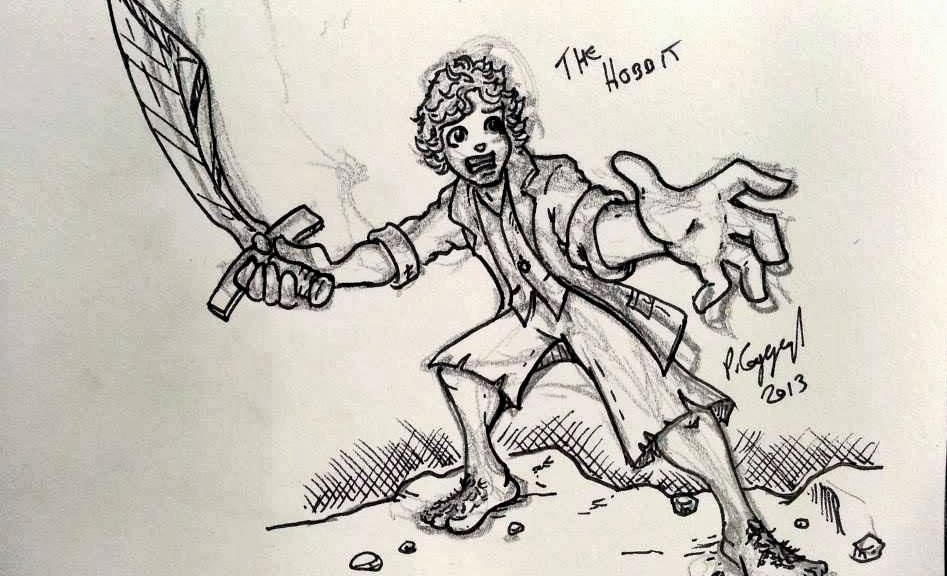
The Hobbit: The Desolation of Smaug Sketch by Paul Caggegi
The Hobbit by Paul Caggegi (http://processdiary.com/)
Unsurprisingly, The Desolation of Smaug ends on a cliff-hanger which will leave you wandering exactly how they are going to fill another 2 to 3 hours with what seems to be a pretty succinct set up of an epic battle. But given much of these prequels have been consciously made to tie in directly to the LOTR films I'm pretty sure Jackson figured it all out years ago.

All in all, I am glad I saw it, even if I did risk a bladder infection. As with each of Jackson’s interpretations there are plenty of beautiful moments, both visually and emotionally. And despite some pithy dialogue we get to escape to Middle-Earth for yet another few hours. It is spectacular but certainly feels drawn out, maybe we didn’t need that second breakfast after all.

The Hobbit: The Desolation of Smaug is in cinemas from Boxing Day.

read more

5 Frightful Tales for Friday the 13th

,

When I was first asked to do a list of films to mark Friday the 13th….well I’ll be honest, I may have sobbed a bit. Quietly. Just out of sight.

There are twelve films in the Friday the 13th series, including the one where Jason went into space, the one with Freddy Krueger and the remake. That is a lot of time I am not going to get back.

Thankfully I was assured I could pick *any* five films I wanted, as long as they're horror pictures.

You can imagine the relief. So here we go – five different horror films, for five different moods, and five different frights.

For the Gorehounds: Night of the Living Dead [George A Romero (1968)]


Top 5 Horror Movies for Friday the 13th

The original and still arguably the best zombie film, Romero starts proceedings with typical B-movie tropes. The opening feels amateurish, overlong, another cheaply made independent picture. Then as the shock of a sudden zombie attack changes the tone, Romero injects the proceedings with an increasing sense of tension. Gruesome imagery lead to an unforgettable climax. A deathless horror classic.


For the Film Snobs: Peeping Tom [Michael Powell (1960)]


Top 5 horror movies for Friday the 13th

Not only was this picture about a murderous psychopath who films his victims at the moment of their deaths – with the audience made implicit by sharing his visual point of view – banned, it ended the career of film-maker Michael Powell. Carl Boehm plays the cherubic Mark, whose mind has been distorted by the invasive psychiatric theories of his father. His crimes are in fact a twisted continuation of the father’s work. Peeping Tom is innovative, chilling – and even features a dance number performed by Moira Shearer, the star of Powell and Pressburger’s The Red Shoes. Unmissable.


For the Conspiracy Fans: The Shining [Stanley Kubrick (1980)]


Top 5 horror movies for friday the 13th

Stephen King disowned this cinematic adaptation of his haunted house story – then later (in 1997) directed his own television miniseries starring Rebecca De Mornay. Kubrick’s earlier film is a tour de force of audio and visual depth, a layered masterpiece of technique. It’s a nightmarish echo chamber that draws in the audience and allows their imagination to drag them deeper. Recent documentary Room 237 for one demonstrates just how much fascination the film still holds.

For the Romantics: Braindead (Dead Alive) [Peter Jackson (1992)]


top 5 horror movies for friday the 13th

While Shaun of the Dead popularized the ‘rom-zom-com’ term, Peter Jackson had already ploughed that gunky furrow with this gruesome comedy. Timothy Balme and Diana Peñalver play our star-crossed lovers Lionel and Paquita (“zoo….what is zoo?”). Standing between them is Lionel’s terrifying mother (Elizabeth Moody, unforgettable), who is then zombified by a weird rat-creature.

Cue kickboxing priests, undead sex and a very Freudian final confrontation between Lionel and Mother. Also, a lawn-mower figures prominently in the proceedings. Finally, a romantic comedy that trades suggestive glances for gushes of bodily fluids of all kinds flying at the screen. One more time everyone – I kick arse for the Lord!


For the Chills: Ringu (Ring) [Hideo Nakata (1998)]


top 5 horror movies for friday the 13th

Hideo Nakata’s film is Kubrickian in its use of sounds and repetitive images. That it takes the theme of Koji Suzuki’s novel – which updates traditional Japanese ghost stories to modern times – and then uses film to illustrate how this takes place shows not only an understanding of storytelling, but a fantastic technical imagination as well.

Ringu terrifies because it stays in the memory. Its scares are based around the idea of a virus that passes from host to host – just as viewers of this film are then compelled to share it with others, in case maybe there is something….other happening here. 

read more