Showing posts with label review. Show all posts

12 Years a Slave: A Review

,

Before the screening for this film began, I ordered a large glass of wine from the bar. I wanted to numb myself. I had not watched any trailers for Steve McQueen’s latest film, or read Solomon Northup’s memoir of his experiences as an abducted slave. Regardless before having seen a single frame, I was already experiencing a strong sense of foreboding.

Steve McQueen's 12 Years a Slave: A Review

McQueen has proven himself to be a film-maker who both is fearless in his subject matter – the deprivation of the Northern Irish political detainees in Hunger is unforgettable – but also fully aware of how film can confront the audience. The topic of slavery within Hollywood has previously been treated as an unfortunate event in history – and so depicted in disaffected fashion as a curio; as a sadistic standby in exploitation cinema; or most famously, entirely justified as in the work of D.W. Griffith’s The Birth of a Nation.

McQueen is not interested in such segues or historical sleight-of-hand. 12 Years a Slave opens with Chiwetel Ejiofor standing among a group of slaves, men and young boys, staring at the camera dejectedly. It is a confronting opening shot, but it also immediately places the audience in that moment. The ambient sound of the cornfield, the buzzing of insects and this silent group, waiting to be told what to do, completely bereft of agency, all combine together to deliberate effect.

Steve McQueen's 12 Years a Slave: A Review

The story skips back in time, introducing Ejiofor’s Solomon as a family man making a comfortable living as an entertainer. He dresses in the clothing of the New York middle class and draws the envious gazes of born slaves, who are baffled by his freedom and equality with his white peers. Solomon is approached by two men who offer him a short profitable job in Washington. During his travels with them, he is drugged and wakes to find himself pressed into a slaver’s ship bound human cargo. There he is stripped of his clothes and name – he learns quickly that any protest about his true identity can lead to his death.

The sudden reversal of Solomon’s fate is a sharp shock, again designed to force a sense of empathy on a modern audience. In addition the shrill violins of Hans Zimmer’s score – acting as a chorus, given Solomon’s own gifts as a violinist – evoke the desperation and pain of these victims of callous slavers.

Sold initially to the morally troubled, but weak-willed William Ford (Benedict Cumberbatch) Solomon tries to makes himself useful, in the hope that his evident skill at carpentry will allow him to convince his owner that he is more valuable as a free man. His plan fails disastrously and he is passed on to Edwin Epps, played by frequent McQueen collaborator Michael Fassbender. Trapped by an unpredictable, brutal sadist, his dreams of escape are slowly ground into dust.

What impresses most is how the torture and abuse of the slaves is not depicted in a sensationalistic fashion, its everydayness making it doubly disturbing to watch unfold. Epps orders slaves who fail to meet a daily quota for cotton picking be whipped, of which there are glimpses in long shots. McQueen also avoids the trope of 12 Years… being a story of redemption for his male protagonist. Solomon instead is forced to witness the suffering of women in particular, an aspect of American slavery that has been sidelined in previous films set during this period.

Cumberbatch’s performance shows what he is capable of when given the chance to escape from Tumblr. Fassbender is simply terrifying, a ball of rage liable to explode at any moment. One tension-filled scene between Epps and Solomon in the dead of night is an acting masterclass.

Steve McQueen's 12 Years a Slave: A Review

However, it is the women on screen that impress the most. The magnetic Lupita Nyong'o gives Fassbender a run for his money during their moments together and the grief of Adepero Oduye’s Eliza at the loss of her children is heartrending. Sarah Paulson plays the wife of Epps and essays another rarity in the film subgenre of slavery pictures, a white woman devoid of any sympathy towards the slaves on her property, actively abusing Patsey (Lupita Nyong’o). Ultimately the plot movements of this film are set in motion by the actions of the women, not the men, with Solomon an especially passive observer.

McQueen has delivered an inspired piece of film that refuses to settle into received ideas of how slavery should be depicted. This is a thoroughly modern and innovative picture, emotionally devastating, but invigorating thanks to directorial technique and the commitment of its cast.

12 Years a Slave is in cinemas from tomorrow - 30 January.


read more

Spike Jonze's Her Reviewed

,

“It’s good to be around someone that’s excited about the world. I forgot that existed.”

Spike Jonze has seen the future and it is very convenient. Her depicts a near-future L.A. that appears to have been annexed by Apple. The digital citizens of this pastel utopia conduct most of their daily activity through virtual space, appear to want for nothing and work at professions that balance creativity with profit, and wear very high pants. The film takes place in an almost insufferably middle-class setting, absent any hint of conflict or deprivation.

Spike Jonze's Her - Movie Review

Theodore Twombly (Joaquin Phoenix) is introduced reading aloud what appears to be a touching love letter. Then comes the reveal that Theodore writes correspondence for a living, occasionally managing both sides of an intimate conversation between the loved ones who employ him. His computer translates his spoken words into beautiful long-hand writing on a printed page, which is then forwarded on to the addressee. The simple act of letter-writing has become fetishised and transformed into a business transaction.

Lonely following the breakdown of his own marriage, the instinctively empathetic Theodore installs a new form of household Operating System that emotionally anticipates the needs of the user and develops an independent artificial intelligence. It is in this fashion he first ‘meets’ Samantha (Scarlett Johansson), whose infectious enthusiasm for life and can-do attitude helps lift Theodore’s funk. Quickly progressing from organising his work life to encouraging the shy writer to go on blind dates, a genuine friendship soon develops between the two.

Having put in the work establishing just how abstract human relationships have become – there’s an awfully funny anonymous cybersex scene featuring Kristin Wiig – Theodore and Samantha falling for one another feels completely natural. Somehow in grafting his story on to a science fiction setting, Jonze has managed to produce a startlingly insightful conversation about how we communicate with one another, both generally and within relationships.

Spike Jonze's Her - Movie Review

Theodore and Samantha may seem like an unlikely couple and at first there’s a suspicion that she is merely behaving affectionately towards him due to her programming. However, the film explores just how dynamic this form of artificial intelligence is. Samantha is not only developing as a piece of software, but discovering her own personhood. Part of the charm of the film is showing how the couple get to know each other more and become genuinely intimate – with all the attendant joys and fears that treasured intimacy brings. Samantha’s arc is that she continues to grow not only into the relationship, but as an individual with wants and needs. Theodore, in his own right, is pulled back into the world, having become insulated by his retreat into technology.

His growing acceptance of Samantha as an individual with her own personality, desires and dreams resembles many relationships. The initial attraction based on a pre-existing preference of what a person is looking for in a partner and then the growing intimacy that comes with truly getting to know someone. 

Another sign of how smart a piece of writing this is can be found in the surrounding characters. Chris Pratt - soon to be appearing on the big screen as Marvel’s next superhero Starlord in Guardians of the Galaxy - features as an easy-going and emotionally secure colleague of Theodore’s. Pratt’s performance as Paul is not only wryly humourous, but sweet-natured and accepting of difference. Olivia Wilde’s ‘Blind Date’, however, is far more fragile, terrified of disappointment in her relationships. Amy Adams plays an old friend of Theodore’s who calmly accepts the highs and lows of life with philosophical grace. Courtesy of both the quality of acting, and the natural dialogue, these characters do not feel like stodgy archetypes. There’s a rich degree of observational insight at work here. 

Spike Jonze's Her - Movie Review

This is also a film that simply looks fantastic. Hoyte Van Hoytema’s cinematography is a wonder, transforming the locations of Shanghai and docklands LA into pristine and richly coloured vistas. Like Michael Winterbottom’s Code 46, or Godard’s Alphaville, this is a stunning example of practical futurism. Very little special effects or green-screen work is in evidence here, besides Theodore’s very funny playtime sessions with a foul-mouthed video-game avatar.

Throw in a soundtrack by Arcade Fire and you have yourself a remarkable multimedia experience.

Her is a film that thrives not only on its performances, courtesy of the intimacy of Phoenix and Johansson’s conversations, but the subtle play of ideas in Jonze’s script. Quite simply one of the most compelling recent films released.

Her is in cinemas from tomorrow - 16 January.


read more

Philomena: A Review

,

Stephen Frears’ latest film takes inspiration from Martin Sixsmith’s novel The Lost Child of Philomena Lee, becoming a subtle meditation on the nature of forgiveness while not shying away from the despicable behaviour of the Irish Catholic Church (link contains information that may be considered spoilers).

Movie Review: Philomena. Judi Dench Steve Coogan

Philomena is played by Judi Dench, who nails the West of Ireland accent. Still grieving for an absent son sold for adoption by the nuns in charge of a Magdalene laundry where she was indentured as a teenager, she finally confesses to her daughter Jane (Anna Maxwell Martin) the existence of this secret sibling Anthony. Steve Coogan’s Martin Sixsmith meanwhile is still reeling from the ignominious end of his career within the Blair administration. A chance encounter with Jane leads her to try to convince him to tell her mother’s story, which he cynically dismisses as cheap human interest misery-journalism fit for tabloids. 

The barely repressed venom in Coogan’s delivery of this line is a neat indication of the script’s intent, which the actor also had a hand in writing. Eschewing the tropes of misery lit and impotent rage at the tragic events surrounding the laundries, Philomena instead not only depicts this injustice but tempers anger with clear-headedness. Martin eventually does agree to meet his subject having successfully pitched the article to an editor, wonderfully played by Game of Thrones’ Michelle Fairley ('who are the bad guys?'), and finds himself won over by the self-effacing plight of this elderly woman.

Movie Review: Philomena. Judi Dench Steve Coogan

What follows is a road movie of sorts, with Philomena and Martin travelling across to the States and back again, hunting down the trail of Anthony fifty years cold. Frears balances flashbacks to the years working at the Roscrea convent, the hardship endured by the young mothers in the laundries and the loving warmth of their brief time spent with their children. Sophie Kennedy Clark, who has gone from playing a British royal in Black Mirror to a naive Irish woman, stands in as a younger Philomena. Her distress at the loss of Anthony is raw and powerful. Dench sells just how enduring this emotion lingers decades later.

A mixture of tragedy and gentle humour eases the audience through the story, with Dench and Coogan introducing a light screwball tone to some of their scenes. There is a recurring joke that Martin is attempting to write a historical work about Russia, whereas Philomena prefers to read dull romance novels and insists on describing the plots to him.

Movie Review: Philomena. Judi Dench Steve Coogan

In contrast, their scenes confronting the 'bad guys' are subtly powerful. Martin is puffed up with righteous anger at the aged Sister Hildegarde who presided over the convent during the 1950s. Philomena, however, remains strong in her religious convictions. She merely wants to know the whereabouts of Anthony so that she can make peace with what happened. The comparison between her enduring religious conviction, being someone directly wronged by the Church, versus the stout atheism of the successful and comfortably middle-class Martin, is repeatedly alluded to.

Ironically Barbara Jefford who appears as the principal antagonist Hildegarde, ranting and raving about fornication, is also known for her portrayal of the sexually sated Molly Bloom in Joseph Strick’s Ulysses (1967).

While the film is pointed in its indictment of how these women and their children were treated, it is not by any means an attack on the Catholic faith itself. Instead it questions the conduct of institutions given full control over the lives of ordinary Irish people and brings them to account. Philomena is an understatedly powerful film.

Philomena is currently in cinemas.

-Emmet O'Cuana

read more

American Hustle: A Review

,

David O. Russell’s American Hustle sees him reunite with the casts of Silver Linings Playbook and The Fighter in what is the latest in his series of films focusing on character instead of plot, lending his actors plenty of emotional space to revel in.

American Hustle: Film Review

Some critics have taken to pigeon-holing American Hustle as an also-ran to Martin Scorsese’s Goodfellas. Thing is, these are two very different films that simply share a period setting as well as a focus on small-time criminals and the cops trying to entrap them.

Whereas Scorsese’s Catholic sensibilities draw him to mine cinematic gold out of America’s rotten heart – perhaps most unforgivably in that ridiculous last shot from The Departed – Russell is instead interested in the fragility of people.

Christian Bale appears on the screen in the opening moments determinedly gluing his comb over to his balding scalp, with a spare tire wrapped around his waist that would make you believe he never did a Bat-push-up. His Irving Rosenfeld runs dry-cleaners and small businesses around New Jersey, but also a neat sideline in conning desperate men who cannot get a loan. His partner in crime is his mistress Sydney Prosser (Amy Adams) who affects a fake British persona of Lady Edith to convince investors to hand over their last $5,000 as a ‘fee’.

American Hustle: Film Review

Unfortunately their latest mark proves to be a Federal Agent. Bradley Cooper’s Richie DiMaso is driven and eager to make his name in the Bureau. He is naively convinced that his black and white perception of the world is true – the memory of Watergate haunts these characters – whereas Irving sees the world as a sequence of greys. Richie pressures Irving and Lady Edith, whom he begins to carry a serious torch for, to entrap the mayor of New Jersey Carmine Polito (Jeremy Renner, terrific is the charismatic community politician).

The stage is set for a love triangle between Irving, Sydney and Richie, as well as a dizzying series of grifts, with it is often unclear whether these characters genuinely feel the emotions they are expressing or are relying on some serious method acting.

Russell highlights this fascinating idea of con men and actors having improvisational skills in common and gives Bale and Adams several generous scenes to show off their talent. The first appearance of Lady Edith is a fantastic case-study of a great actor playing someone who is a bad actor. The setting also allows for not only anachronistic period detail, but the delightfully cheesy poor sense of class that these characters have. Richie’s furious demands for increasingly expensive hotel suites to impress his long line of marks as part of his operation are particularly telling.

American Hustle: Film Review

Much of the film's promotional campaign has centered around Jennifer Lawrence. Her neurotic Rosalyn is a harpy with peroxide hair already trapped in the role of a suburban wife while still a young woman. She also happens to be the loose cannon at the heart of this scam who risks blowing the whole deal wide open.

Russell’s grand theme here is whether graft and corruption can actually serve the greater good. As Irving tries to explain to Richie, Watergate has not opened the floodgates on moral righteousness. American Hustle in that respect has a far more interesting perspective on working class crime than Goodfellas. It is also an acting masterclass, which takes the time to allow the performers to take ownership of their scenes.

American Hustle is currently in cinemas through Roadshow.


read more

Year in Review: What You Missed on Hopscotch Friday

,

Well it's not quite a year in review, as we've only really been around for four months, but for those four months we've enjoyed your company and support. So, thank you for that, we greatly appreciate it and hope to see you continue on the journey with us into 2014.

There's loads to come, with some new features and regular columns from our wonderful contributors. But for now, here's the top posts from 2013 for you to read as you nurse tomorrow's hangover.

People In Your Neighbourhood: Peter Neill


Year in Review - Top Posts - Peter Neill - Music Photographer
Coldplay by Peter Neill
In our second People In Your Neighbourhood feature I spoke with Peter Neill, wedding photographer turned concert photographer, who happens to also be a genuine and down to earth bloke who hasn't yet let hanging out with the likes of U2 and Justin Timberlake go to his head.

Read about Peter here.

The Time of the Doctor: The Long Con


Year in Review - Top Posts - The Time of The Doctor Review
http://www.bbcamerica.com/doctor-who/photos/time-doctor-sneak-peek
Emmet reviewed the Doctor Who Christmas special, the Time of the Doctor arguing that the resultant bellyaching from fans and critics was unjustified. Instead Emmet suggests that this, Matt Smith's swansong, was presented just as it should have been, remembering, of course, that regeneration came about to provide the successful show with longevity beyond the retirement of the original Doctor, William Hartnell. Nothing more, nothing less.

Read Emmet's review of Time of the Doctor here.

Get Your Kinky On


Year in Review - Top Posts - Still Kinky - Sex Party

I'm wondering if this says more about you than it does us! Eliza's musings on sex with people watching and dancing like nobody is struck a nerve or peaked the curiosities of many. She's a straight shooter, but still showed us her vulnerability at this new experience, which I think many found to be both familiar and refreshing.

You can read Eliza's thoughts on the experience here, and in part two, here.

Totally Rad Adventure


Year in Review - Top Posts - Totally Rad Adventure - Space Pyrates to SPX

Giving a platform to an amazing comic creator has been a real pleasure for Hopscotch Friday, and Caitlin's detailing of her trip to the Small Press Expo (SPX) in comic form has proved that you like it too. Caitlin's comic proves that even in drawn form, sometimes reality is funnier than fiction.

Caitlin's SPX adventure in four parts can be found here, here, here and here.

See you in 2014!


That's a wrap for 2013! We want to thank you, our readers, for your ongoing support and hope to see you continuing the adventure with us in the New Year.

I'd also personally like to thank all of Hopscotch Friday's contributors. This blog would just be boring old me if it wasn't for the effort you put in out of the goodness of your own hearts and in pursuit of your passions. For your contributions I am thankful, but so too am I grateful for the opportunity to share your talents with the blogosphere.

Don't forget you can join the conversation via Facebook, Twitter, Google+, Instagram or Pinterest.

-Stevie O'C
read more

Peter Jackson's The Hobbit: The Desolation of Smaug Reviewed

,

When I first heard that Peter Jackson would be making The Hobbit into a prequel film his Lord of the Rings series, I was excited. When I heard there was enough material to fill two films, I gave him the benefit of the doubt. When I heard it was going to be a trilogy, I became a little sceptical.

I'll admit I've not read the book since high school, and in the context of having read The Lord of the Rings trilogy and The Silmarillion, it's a bit of a blur as to what was The Hobbit and was was added from the overarching lore. However, if my shoddy memory serves, the basic premise is that a homebody gets talked into going on a treasure-hunting adventure with a bunch of fun-loving Dwarves, serving to illustrate that the smarts of an unlikely hero can win the day.

The Hobbit: The Desolation of Smaug Reviewed

Thus far the movies have made Bilbo (Martin Freeman) a bit player in the larger story, which is now more about a disenfranchised people questing to reclaim their homeland from a dragon, and redeem themselves from a fall-from-grace.

While this second Hobbit film is, in some respects, better than the first, I found it to be riddled with pointless scenes. For much of the film I truly wondered where this garden path was leading me, desperately seeking some sort of arc in the story. With no beginning and a cliff-hanger ending I find the pursuit of a grand finale, some 12 months away, a flimsy excuse for stringing together a bunch of disconnected scenes of our heroes’ quest to the Lonely Mountain.

In The Desolation of Smaug we continue to explore Middle-Earth with our heroes who are still being pursued by the pack of Orcs that found them at the end of An Unexpected Journey. They encounter Beorn (Mikael Persbrandt) - a were-bear and giant spiders, and are captured by the Elves of Mirkwood Forest, only to escape and be smuggled into Lake-town by Bard (Luke Evans).

The Hobbit: The Desolation of Smaug: A Review

Familiar LOTR tropes are rehashed but not built on or treated in any unique way: Elves still hate Dwarves; if you're cut by a Morgul blade, you need Kingsfoil (a weed) and Elven magic to heal the wound. Yep, we know.

Unfortunately, neither are the characters progressed much here, rather passing relatively unaffected from ordeal to ordeal. Instead, most seem to serve a function: Balin (Ken Scott) is the wise advice-giver and problem-solver, Thorin (Richard Armitage) plays brooding hero, Kili (Aidin Turner) provides some comic-relief, and poor Bilbo has been demoted from titular protagonist to ‘that guy who'll always get them out of trouble’.

Despite this, it does all seem worth it when our band of heroes finally reaches the Lonely Mountain and encounter Smaug the Dragon (voiced by Benedict Cumberbatch).

By this stage in the film I had a serious need to pee. But from the moment Bilbo entered the cave of riches and awoke the slumbering, smooth-talking dragon, every scene featuring this amazingly realised character was worth crossing my legs for.

It is here that the film really begins to shine. Perhaps the dialogue is lifted wholesale from Tolkien’s original, or maybe it’s because Bilbo is finally given a chance to talk rather than bumble along, but something changes and the film is all the better for it.

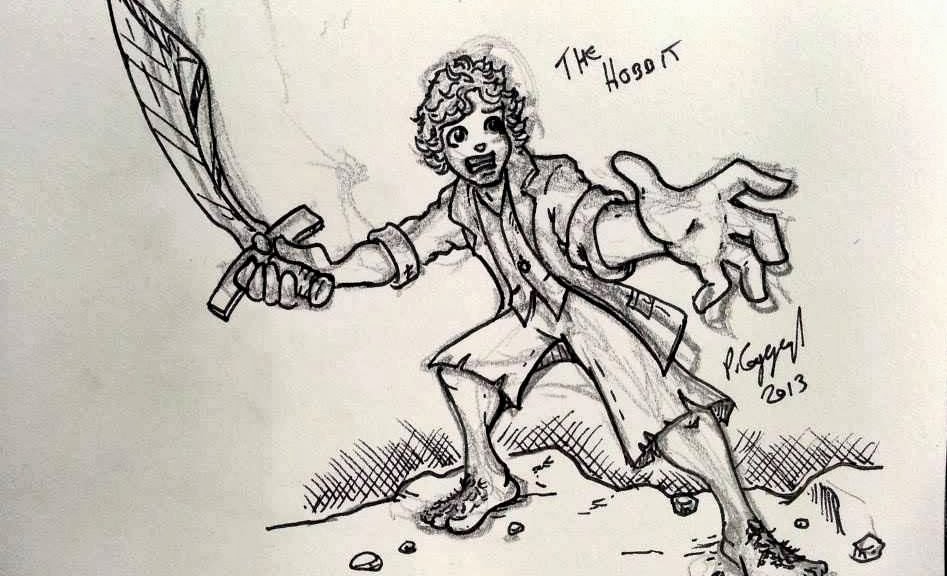
The Hobbit: The Desolation of Smaug Sketch by Paul Caggegi
The Hobbit by Paul Caggegi (http://processdiary.com/)
Unsurprisingly, The Desolation of Smaug ends on a cliff-hanger which will leave you wandering exactly how they are going to fill another 2 to 3 hours with what seems to be a pretty succinct set up of an epic battle. But given much of these prequels have been consciously made to tie in directly to the LOTR films I'm pretty sure Jackson figured it all out years ago.

All in all, I am glad I saw it, even if I did risk a bladder infection. As with each of Jackson’s interpretations there are plenty of beautiful moments, both visually and emotionally. And despite some pithy dialogue we get to escape to Middle-Earth for yet another few hours. It is spectacular but certainly feels drawn out, maybe we didn’t need that second breakfast after all.

The Hobbit: The Desolation of Smaug is in cinemas from Boxing Day.

read more

Neil Gaiman's Fortunately, the Milk: A Review & A Competition

,

Neil Gaiman's Fortunately, the Milk is the charming tale of what happens when Dad gets waylaid on the way home from the shops, to which he went to pick up some milk.

Somehow between the shops and home, Dad manages to find himself travelling through time with a dinosaur in a hot air balloon, moving through time and space, and fending off a tribe of natives, a family of vampires and a gaggle of aliens!

It truly is treacherous on the way home from the shops.

Fortunately the Milk Neil Gaiman Chris Riddell

You know he's just run into a neighbour, stopped for a chat and lost track of time, but that's far less enjoyable than dinosaurs, time travel and world saving milk!

The interludes from the children are especially lovely, as they patiently and attentively listen to their father's long-winded excuse for being delayed.

The writing is quintessentially Gaiman, by which I mean thoroughly English, and pleasantly whimsical. Gaiman has such a great command of language, making Fortunately, the Milk almost lyrical in expression and a joy to read.

The illustrations are beautifully detailed, and quite mature for a children's book, or at least compared to what I remember from children's books when I was younger.

Presented in black and white, Chris Riddell's illustrations compliment the story as it is being told, with the text printed in and around many of the drawings. I particularly liked the portraits of characters staring out from the book and drawing readers in.

Fortunately the Milk Neil Gaiman Chris Riddell
Funny how Dad looks just like Neil Gaiman himself!
The result is that you can't help but smile reading Fortunately, the Milk, be you grown up or child.

As someone who is lactose intolerant, I thoroughly recommend Fortunately, the Milk, and although it's aimed at kids in the 8-12 age range, I don't see anything wrong with having a few great children's books tucked away in a grown up bookshelf.
Thanks to the lovely people at Bloomsbury, we have a copy of Neil Gaiman's Fortunately, the Milk, to give away! Yay!

All you have to do is fill out the form below and you're in with a chance! And don't forget to share the love on Twitter or Facebook. Good luck! *Fine print below the form.

Competition closed! Congrats to our winner and thanks to everyone who entered!


The fine print: Entries close 11.59pm on Friday 13 December 2013. Your details will not be used for any purpose other than for the delivery of your prize. Hopscotch Friday and Bloomsbury Publishing do not take any responsibility for the damage to, loss or delay of prizes sent to winners - unfortunately, that's in the hands of Australia Post. The decision of judges is final and no correspondence will be entered upon. One entry per person. Any subsequent entries will be void. Incorrect answers are void. Prizes are not redeemable for cash or any other currency. This competition is open to Australian residents only. Any comments or queries should be submitted via the contact form or in the comments below.
read more

Danielle Hawkins' Chocolate Cake for Breakfast: A Review

,

Thinking about it, it’s not often that I read a book about New Zealand, or set in New Zealand, or that has anything to do with New Zealand.


Danielle Hawkins’ Chocolate Cake for Breakfast is the story of Helen McNeil, a country vet in, you guessed it, New Zealand, who quite literally trips over All Black Mark Tipene in a place you’d hardly expect – a small town at her cousin’s party. What ensues is a whirlwind romance interspersed with the daily life of a country vet.

That is, until a ‘little something’ changes everything.

If you haven’t figured out what the ‘little something’ might be then you aren’t familiar with chic lit tropes, or for that matter any trope relating to romantic comedies aimed at women.

Why can’t she just enjoy the whirlwind, chalk it up to experience and live a happy life? Why can’t they figure their differences actually complement each other, get married and live happily ever after? Or why can’t he turn out to be a bit of a jerk, she breaks it off, is heartbroken but gets over it because she loves her life, and is a strong woman? /rant

Instead Mark and Helen become forever linked, like it or not.

I liked Helen. She’s intelligent, well spoken, humourous, and independent. I found her to be both familiar and relatable. If Helen is not a reflection of you, then she is definitely someone you know.

The development of Helen as a character is far more rounded than that for Mark, which can probably be attributed to the fact that it’s Helen’s perspective we’re taking. It does seem a shame though, as Mark is relegated to tall, dark, handsome and mysterious. Although, to be honest in the absence of any further detail, I imagined him to be far less 'mysterious' and a little bit one note, in a very stereotypical and possibly unfair conception of rugby players.

I was struck by two things when reading Chocolate Cake for Breakfast; first, the intimate detail given to some of the veterinary procedures including those that are particularly stomach churning. Hawkins herself being a vet, this is understandable. But secondly, the lack of any detail of Helen and Mark being intimate, properly intimate. The tracking of events ends just as one flops into the bed beside the other. Maybe this is just me, but why all the detail on one aspect of Helen’s life but not the other? Not that it needs to be in graphic detail, but surely sex is an integral part of romance?

As a result a lot of the romance is based on the conversations Helen has with other people about her relationship, or her own internal monologue, as opposed to the relationship itself. This, I believe, is inherently female, in that us ladies like to over think things and twist them into situations that may or may not exist. For example, what could this famous, wealthy and sought after sports person who can have any lady he wants possibly want with me, a country vet? We all do it, we all know we shouldn’t and so does Helen.

All in all I enjoyed Chocolate Cake for Breakfast, it’s an easy read with a familiar plot line. It's a bit of escapism that's perfect for a holiday read or a break at the weekend with your feet up.

Chocolate Cake for Breakfast by Danielle Hawkins is published by Allen & Unwin. 

-Stevie O'C


read more

Haganai (I Don't Have Many Friends) Reviewed

,

Haganai (I Don't Have Many Friends) follows the story of Kodaka, a teenage boy with sandy blonde hair, who transfers to St Chronica’s Academy mid-year. Kodaka manages to immediately get all of his classmates offside through a series of misinterpreted events that make him come across as physically and sexually aggressive. At St Chronica’s he meets Yozora, whom he interrupts mid-conversation with her imaginary, and only, friend. What Kodoka doesn’t know is that he has already met Yozora, but not as he’d recognise her.

Haganai I Don't Have Many Friends Anime Review

Kodaka is generally harmless despite the perception that he’s a bully, while Yozora is a very angry young lady. Having no real friends, she starts the extracurricular Neighbour’s Club, initially with the intention of attracting Kodaka, but soon others begin to join as well. One of the first is Sena the headmaster’s daughter, she is attractive and blonde and therefore the subject of the leering eyes of her male classmates. She’s the token cheesecake, and like Yozora, Sena has no friends of her own.

Sena and Yozora do not get along, with Yozora apparently determined that they never will. In fact, Yozora is outright mean to Sena, giving her the nickname ‘Meat’, which Sena does not mind as she has never had a nickname before, figuring that a bad one is better than none at all. In the beginning their relationship is bearable because there’s the potential for it to get better, however by the end of the season the character of Yozora really begins to grate. She is so unconfident in herself that she needs to bully Sena at every opportunity, while poor Sena takes it, almost thankful for the attention. It’s a real shame, because there are some genuinely enjoyable moments that are destroyed by the relationship between these two.

Haganai I Don't Have Many Friends Review Anime

The rest of the club-members include Kobato, who is Kodaka’s sister and convinced she’s some sort of vampire; Yukimura, Kodaka’s stalker who for some reason thinks she’s a boy; Rika, the super-intelligent science-geek who is actually quite perverse and perverted, and who also has a tendency to speak of herself in the third person; and Maria, the ten-year-old nun responsible for supervising the club.

The first thirteen episodes follow the formation of the club and the various activities they employ to get to know each other better, after all the purpose of the club is to make friends. The final episode is the one that both bothered and interested me the most. The activity for the day is a round-robin story, during which the members take turns writing a page of the story, one after the other. It’s here that Yozora is particularly cruel to Sena, whom she writes into a rape scene. It’s portrayed as though Sena is being attacked and eaten by some fantasy monster, but it is both the idea and hearing Yozora dictate her words that turn the stomach. I know teenage girls can be cruel, but I would have hoped they wouldn’t go writing rape scenes about their supposed friends.

While true of the whole series, this final episode also seems to be the most self-aware and self-deprecating. When it comes to her turn, Rika, who herself has previously spoken of her own rape fantasies, writes an explicit mecha-on-mecha sex scene. When Kodaka points out that the story no longer makes any sense, Rika reminds him and the others that nobody actually cares, just as long as there’s a sex scene in the end.

Haganai I Don't Have Many Friends Review Anime

This, it appears, is exactly what Haganai is about. Nobody cares about what happens in between, as long as there’s some gratuitous wobbly booby shots along the way, and Haganai has a lot. I want to understand anime, I really do, and the more I think about it the more I realise that maybe Haganai is the best place to start when it comes to grown up anime. The characters are clear tropes of Japanese animation, and they know it. The look, feel and plot lines also have (blatant) hints of familiarity, from teenage girls in short skirted school uniforms, video games about relationships and sex, characters believing they are immortals from the underworld, exaggerated wobbly girl-bits (and nudity) and even a mecha-sex scene or two.

However, Haganai is desperately uneven. While not without some funny and almost tender moments, these are often overshadowed by the almost unrelenting nastiness of Yozora. Shame, because at the outset Haganai had potential.

Haganai: Season One Collection is available on DVD and Blu-Ray here through Madman Entertainment. It's rated M and contains sexual references, sexual violence and animated nudity.

read more

Deep Sea and Foreign Going: A Review

,

I must admit that a non-fiction book about shipping is not something I would ordinarily pick up to read. As Deep Sea and Foreign Going reveals, this is perhaps not a reflection of my interests but the low profile of the shipping industry in our everyday lives - even though it brings us '90 per cent of everything'.

Book Review Deep Sea and Foreign Going by Rose George

In an effort to find out more about an invisible industry that has such a significant role in bringing us the goods we use every day, UK writer Rose George boards the container-ship Maersk Kendal at the English port of Felixstowe. From here she travels through the Suez Canal and treacherous Somali waters, eventually finishing her journey in Singapore. Interviewing the ship's crew, captain, and various other players in the modern shipping industry - from chaplains to pirate negotiators - George has written a book that is both intriguing and informative.

Ships bring us everything from mobile phones to furniture, cars and food, but most of us know very little, if anything, about it. The book opens with a discussion of how the shipping industry has largely been removed from our everyday consciousness. This is partly because ports are no longer part of residential neighbourhoods, and in a post-9/11 world, security concerns make them nearly impossible to visit (when was the last time you saw a container-ship up close?). Even though we don't see it, the magnitude of the modern shipping industry is astounding - if all the containers of shipping company Maersk were lined up, they would stretch half way around the world.

It is no surprise then that this book taught me a lot about aspects of shipping I would normally not think about. For example, in many cases seafarers work for months at sea with very little contact with home, few recreation or support services and, until 2012, international standards allowed them to work a 98-hour week. In heartbreaking interviews the seafarers talk of their experiences with search and rescue missions at sea and offer anecdotes of modern shipwrecks, which although sad are nonetheless fascinating.

Deep Sea and Foreign Going by Rose George A Review
By evanblaser via Flickr
One aspect of modern shipping that perhaps more of us are aware of is the rise of piracy. As George travels through the Somali waters she gives a thorough insight into the dirty and desperate trend that in 2010, Harvard Business School called the 'best business model of the year'. Surprisingly, shipping companies are forced to negotiate with pirates using expert consultants such as John Chase, whose interview paints a chilling picture of the business. George finds that pirates are rarely prosecuted due to the mobile nature of witnesses and the need to find a nation willing to try them as incidents often take place in international waters. As a result, stamping out piracy is a real challenge.

Deep Sea and Foreign Going by Rose George, A Review
By Grolltech via Wiki.
Being an animal lover, one of the most disturbing revelations was the impact that the growth in the shipping industry, and our increasing intrusion on the oceans, is having on marine life. George's research describes how we are not just polluting the oceans with plastic and chemicals, but also with noise from thousands upon thousands of ships. This comes from the use of seismic surveys and echoes from fish finders, which disturb and disrupt marine animals that are sensitive to sound waves. Research shows that every ten years the noise from commercial shipping doubles, and that this increasing disturbance has effects on the communication and feeding habits of whales, dolphins, fish and other species.

Deep Sea and Foreign Going is a fascinating book if you want to know how your iPhone, television or even baked beans made it into your home, and the incredible stories surrounding its journey. Pick it up and give it a go, even if it is a topic that wouldn't usually be on your radar.

Deep Sea and Foreign Going: Inside Shipping, the Invisible Industry that Brings You 90% of Everything by Rose George is published by Allen & Unwin and available for purchase here.

read more

Thor: The Dark World Reviewed

,

I’m really not sure why Thor: The Dark World is getting such mixed reviews. What is it people go to Marvel movies for? A hero? A villain? A love interest? A world at risk? A generic-y storyline bolstered by explosions, fight scenes, superheroes and space aliens? Oh for the love of clichés! If you answered yes to any or all of these, then you really have no excuse for being anything other than delighted with this latest instalment in the Avengers compendium.

Thor 2 The Dark World Thor and Loki A Review

I’m mildly bothered by the fact that there seems to be this growing impression that we can’t just go to a film for the sake of enjoyment. For enjoyment purposes, only, nothing deeper or more meaningful. Why does it matter that the first half of the film is exposition aimed at a more superficial audience that needs everything explained to them? Why does it matter that this is a pure marketing ploy to pull in a broader audience? Why does it matter that you haven’t yet realised that as a comic book fan this film is not actually for you, specifically, but for the masses?

As far as plots go, this one is pretty much the off-the-shelf variety. Once upon a time there was a war between the Asgardians and the Dark Elves, the latter of which were all but wiped out except for the most important ones who escaped and have remained in a state of suspended animation. Loki (Tom Hiddleston) is in prison, Thor (Chris Hemsworth) is sad after having neglected his love life to clean up after his brother, and Jane Foster (Natalie Portman) has moved to London. As the nine realms move towards alignment, Jane somehow manages to be in the wrong place at the wrong time and is infected by the Dark Elves’ weapon of choice, the Aether. Cue the awakening of head Dark Elf Malekith (Christopher Eccleston) who now wants to bring the nine realms into darkness; the motivation of Thor who wants to save Jane (oh, and the nine realms too, if you wouldn’t mind); and the bringing together of two brothers torn apart by the selfish actions of one.

I’ve read that some are calling it The Lord of the Rings in space, but for me it felt more akin to Doctor Who, with the treatment of dashing between worlds like the Doctor’s movement through wibbly-wobbly timey-wimey. Also Malkith’s band of not-very-merry elves would not have been entirely out of place beside the Silence, Ood or Cybermen.

Thor 2 The Dark World Review Dark Elves

In any case, by now you’ve probably guessed that Thor: The Dark World is not a perfect example of cinematic excellence. It is a little disjointed in parts, and it does feel like two films pasted together somewhere in the middle. The tone of the first half differs from the latter, as it hastily tries to deliver the necessary exposition (which, actually may not be so necessary), while the second half seems to take itself far less seriously and almost becomes a romp. That said, I still left the cinema feeling as though my tight-arse-Tuesday $12 ticket was worth it.

It seems all the reviewers are talking about Tom Hiddleston’s Loki, and really why wouldn’t you? He does appear to be having great fun playing Loki, with the character in the latter half of the movie actually beginning to live up to his mischief-ness through a series of well-timed quips and the provoking of his overly serious half-brother. Chris Hemsworth does what he can with Thor, who is a slightly more rounded character in this second film. In the first, I found him severely lacking and one dimensional, but here there’s a little more to Thor, with my favourite scene the one apparently recommended by Joss Whedon – topless Thor! It’s not the topless-ness I loved rather how Hemsworth’s overly buff chest and arms are paired with what I have come to call ‘Thor-thinking-face’. It’s only a few seconds, but its inclusion is worth it even though it is entirely gratuitous.

Thor 2 The Dark World Review Thor and Heimdall

If I’m honest, Natalie Portman’s Jane Foster is the biggest disappointment. In fact, I’m beginning to question Portman’s talent altogether as her portrayal of Jane in both films leaves a lot to be desired. She spends most of the film either actually unconscious or acting that way. While others have criticised it, I actually enjoyed the interludes of camp from Kat Dennings’ Darcy Lewis, but I did think Idris Elba as Heimdall was a little underutilised – I get the feeling there should have been slightly more of him, but it may have been left on the cutting room floor. Christopher Eccleston’s Malekith is foreboding and driven. It is clear that he has waited a long time to do this one thing and that is his focus, which Eccleston executes nicely from beneath piles of prosthetics and makeup.

One issue I did have with Thor is entirely a side issue and not something I blame this film, specifically, for. I feel that the portrayal of intellect and science is increasingly sidelined in film and many other forms of popular culture. Thor, here, is a symptom. Jane Foster is presented as being muddle headed and under-confident, yet it is her idea that saves the world, Thor just happens to assist in the facilitation. Similarly, Stellan Skarsgard’s Erik Selvig is outright mad, but again, it is his scientific knowledge that contributes significantly to the survival of not only the populations of earth, but of all the nine realms. This fact is all but sidelined, especially as it goes unrecognised and unrewarded.

Overall, expect little and have yourself a good time with Thor: The Dark World - in cinemas now.


read more

Relish: My Life in the Kitchen Reviewed

,

Lucy Knisley's foodie memoir Relish: My Life in the Kitchen landed in my lap by way of my husband who picked it up at the Melbourne Writer's Festival. He's a graphic novel aficionado but, well, they've never really done much for me. However Knisley's book may well be a meeting point for the two of us.

Lucy Knisley Relish My Life in the Kitchen A Review

The daughter of a chef and a gourmet, Relish is a series of short stories detailing Knisley's experiences growing up in a home where food was kind of a big deal.

Knisley is clearly a woman after my own heart, as essentially Relish is a book about a love of food and the journey it can take you on in life. Food discoveries, rebellion and comfort through food, the way certain kitchen smells transport you back to another time and place...This is Relish, a collection of food-related experiences, or is it experiences related to food, that are hopefully familiar to just about everyone. They certainly were to me.

At heart, I am a lover of good food although I do tend to suffer the same fate as Knisley with her occasional hankering for complete and utter junk. In this way Knisley's stories are relatable. She covers not only her fancy food loves but her dirty little food secrets too.
 
Lucy Knisley Relish My life in the Kitchen Review Comic Memoir

The record of events is not presented in traditional memoir format, neither is it your typical graphic novel. Instead the stories are told via the text, with comic strip illustrations presented to accompany and enhance the storytelling. Beautifully presented, I really enjoyed both Knisley's writing and her drawings and found them to be complimentary in rounding out the experience.

What's also fun about Relish is the inclusion of illustrated recipes at the end of each chapter, taking Knisley's  life experiences and bringing them into your own, should you so choose.

read more

Thor('s Day): The Dark World

,

Today is Thor's day. It also happens to be release day for Marvel's Thor: The Dark World. See what they did there?

Marvel's Thor 2 The Dark World with Chis Hemsworth, Tom Hiddleston and Natalie Portman

Earlier this week I watched David and Margaret pan this, the latest in the Marvel franchise and the sequel to 2011's Thor (but which takes place after the events of The Avengers). They said it's same ol' same ol'. They said there's nothing new to see here. They said it's superficial, bang, crash and pretty-boy heroes.

To be honest none of this comes as a surprise to me. In fact my thoughts as I watched these armchair critics from the comfort of my own armchair were firstly, what did you really expect? And with that in mind, do you really care that it's likely to be superficial, generic story telling and fantastical escapism? Like, really care?

I haven't seen Thor II but the likelihood of me doing so is pretty high. As you may have gathered by now, I have a completely at arm's length happily married lady crush on Tom Hiddleston, who plays the mischievous adopted god, Loki. I also reckon if Chris Hemsworth knocked on my door trying to flog me Foxtel I'd obligingly invite him in, brew him a cup of tea and hand over my credit card details.

Marvel's Thor 2 The Dark World with Chis Hemsworth, Tom Hiddleston and Natalie Portman

Without having seen the film I'd say Margaret and David would be close to spot on with their assessments. So too am I confident that this is exactly what Marvel is pitching at. Given the amount of whinging from fanboys that accompanied the release of Iron Man III for its deviating from the dogma I can well believe they've gone back to formula - world at risk, motivated hero, love story, hero challenged, world saved - for this stop gap between the last and the next Avengers films.

I personally really enjoyed Iron Man III. I thought it was, while imperfect, relatively intelligent and poignant for a superhero movie. For me it was an interesting commentary on heroism, politicking and media, with the added bonus of Robert Downey Jr. But I can't expect all Marvel films to do this. I, in actual fact, am probably not the Marvel target market. I'd argue neither are David and Margaret.

The Marvel films are a product. First and foremost. The Marvel films are not produced for art. They are a commercial enterprise, which, in many respects, is what cinema has become.

Director Alan Taylor has himself spoken out about the treatment his film was given by the studio. According to Taylor, re-shooting, rewriting and the inclusion of new scenes even after production has ended is 'the Marvel way'. In a brief interview with Collider, Taylor admits to the inclusion of additional scenes featuring Loki, which one can only imagine have been added on the back of the audience and fan reception to Hiddleston's portrayal of the character and growth in his personal capital following the success of The Avengers.

In another interview with the Huffington Post, Taylor is oddly overt about the structure of the final film, of which the first 45 minutes is exposition. According to Taylor this all came about in post, or as he put it, was 'discovered along the way'. His preference, it appears, was for earlier versions of the film, which placed more 'trust the audience'. But the 'decision was made', leaving one to wonder who is really in control.

Well, in actuality I was never really in doubt. It's made all the more obvious with the inclusion of a snippet in the middle of the credits, which is apparently a blatant marketing ploy for the soon to be released flick Guardians of the Galaxy from yet another Marvel movie universe. Directed by James Gunn (who has also directed Guardians), Taylor notes that it's a shift in tone and probably not what he would have done with the scene. Interesting. But as Taylor notes, it's Marvel's way to make things 'better'.

In any case, Marvel can pretty well count on my money at the box office on this one. I don't always want smarts from my superheroes. Sometimes I just want muscly blokes with superhuman abilities making things go boom. It's about escapism, fantasy and zoning out for a couple of hours. I'd be silly to expect more.

Thor: The Dark World is in cinemas from 31 October.


read more